Guide
Airport Essentials for Modern Men (The Kit That Makes Travel Effortless)
Last updated: June 2026
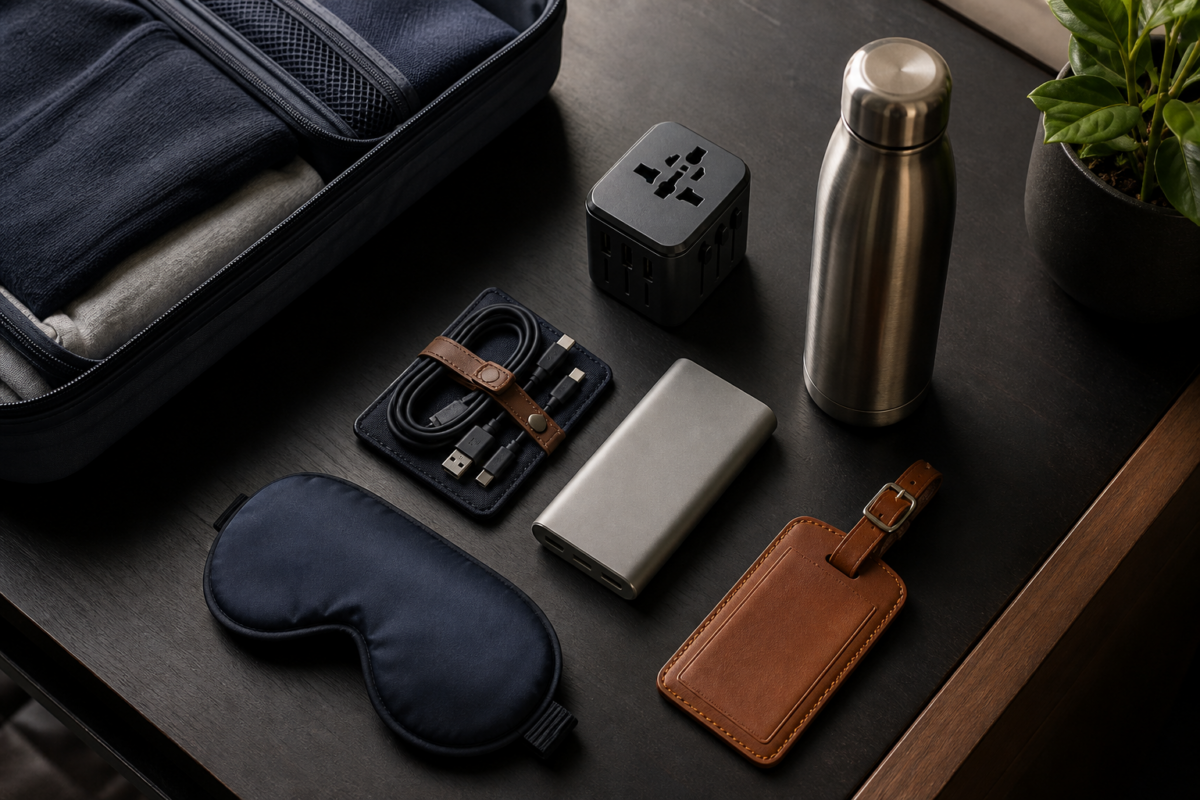
Quick answer: The airport essentials worth owning are noise-cancelling headphones, a slim travel wallet, a compact cable organiser, a quality carry-on or weekender bag, and a leather luggage tag. Add a portable battery, a good travel adapter, and a water bottle, and nothing at the airport will catch him unprepared. The goal is a kit that removes friction from the moment he leaves the house to the moment he lands — not gadgets for edge-case scenarios.
This is the editorial piece: the complete airport kit, explained properly.
The philosophy of a good airport kit
Most airport gear is bought reactively — he forgot a cable, bought a bad adapter in the terminal, grabbed a bottle of water because his wasn’t full when he got through security. Reactive buying at airports is expensive and bad. A deliberately assembled kit eliminates all of that permanently.
The airport experience breaks into five phases: leaving the house, getting through security, the terminal, the flight, and landing. A well-built kit addresses each phase, with no surplus.
The one-line rule: Your airport kit should make the process invisible — if you’re thinking about the kit at the airport, something in it isn’t working.
The complete airport kit, phase by phase
Phase 1: Leaving the house
The essentials that make getting out of the door frictionless.
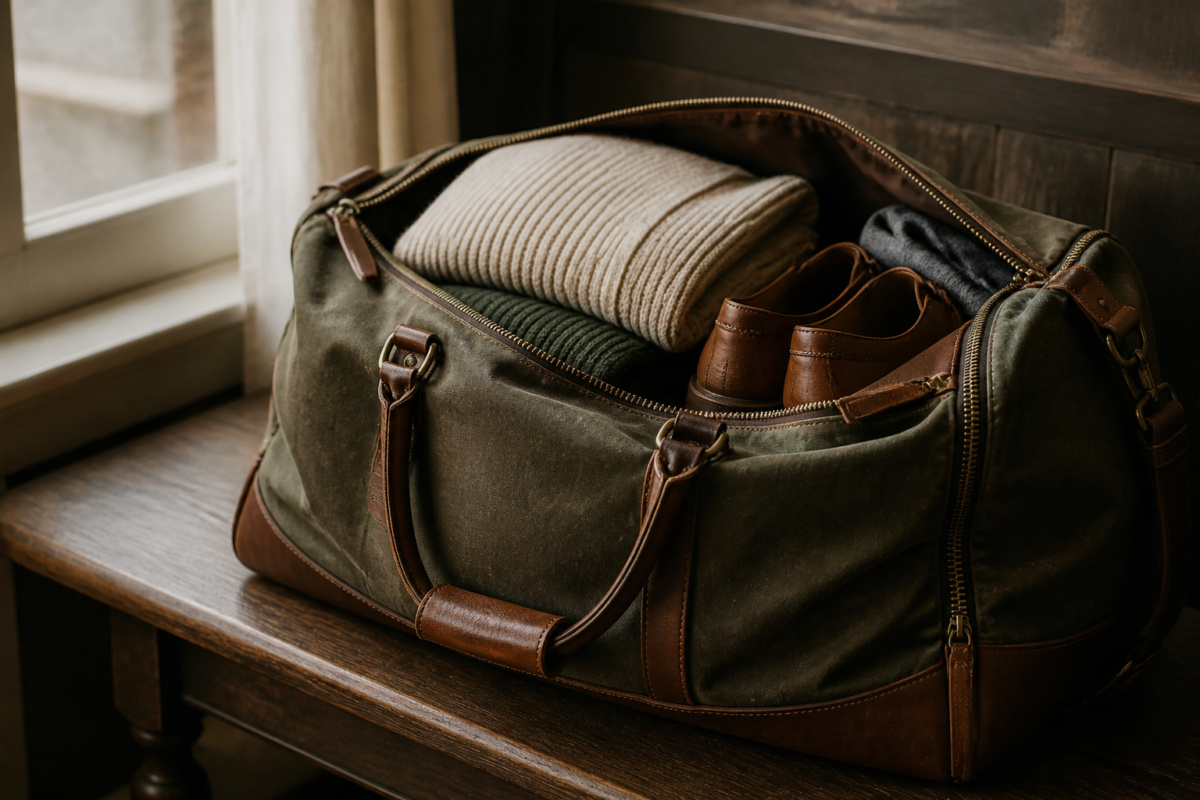
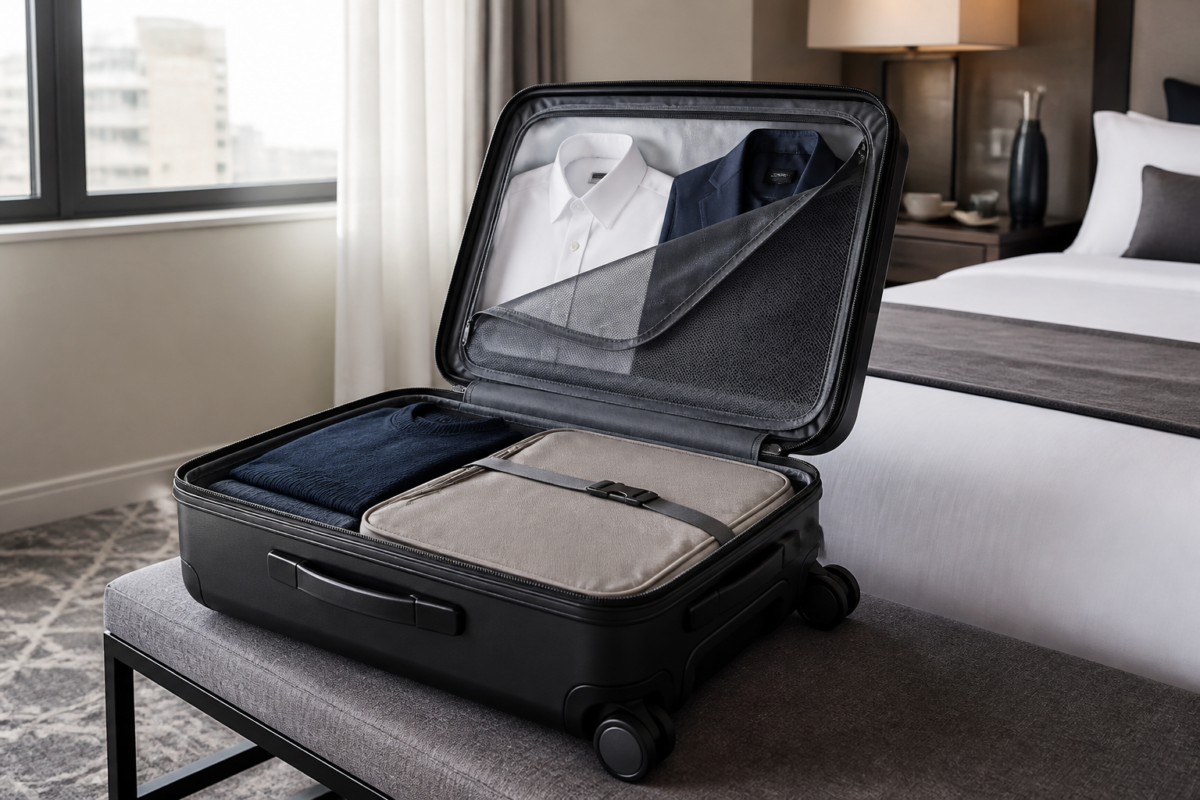
A quality carry-on or weekender bag. The most important decision is the bag. For a two-night trip with only cabin luggage, a 24–28L travel backpack or a 35–40L weekender gives enough space without encouraging over-packing. See our guides to the best travel backpacks for business travel and best weekender bags for men.
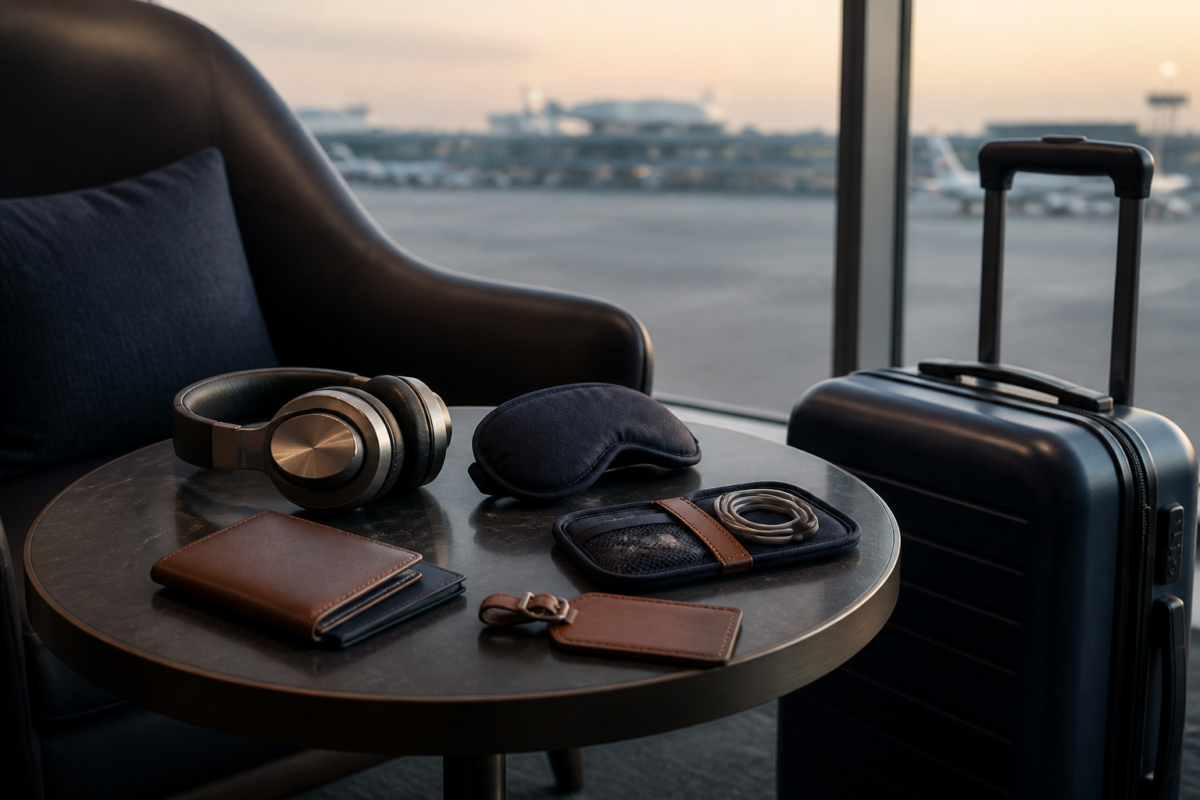
A slim travel wallet or document organiser. Passport, boarding card (or phone), payment cards, travel insurance reference, and some local currency. Everything in one place, accessible in a second. The Bellroy Travel Wallet (around £60–£80) or Smythson Panama Travel Wallet (around £150–£200) handle this properly.
Packing cubes. For carry-on travel, packing cubes make the difference between a bag that stays organised throughout and one that becomes a jumbled mess by day two. Peak Design Packing Cubes or Eagle Creek Specter compression cubes are the worth-owning options.
A leather luggage tag. Even for cabin bags — it identifies the bag quickly at the belt and on the overhead-bin clip. A monogrammed leather tag from Aspinal or Ettinger (around £35–£55) is the no-brainer purchase.
Phase 2: Getting through security
The security phase rewards preparation and punishes disorganisation.
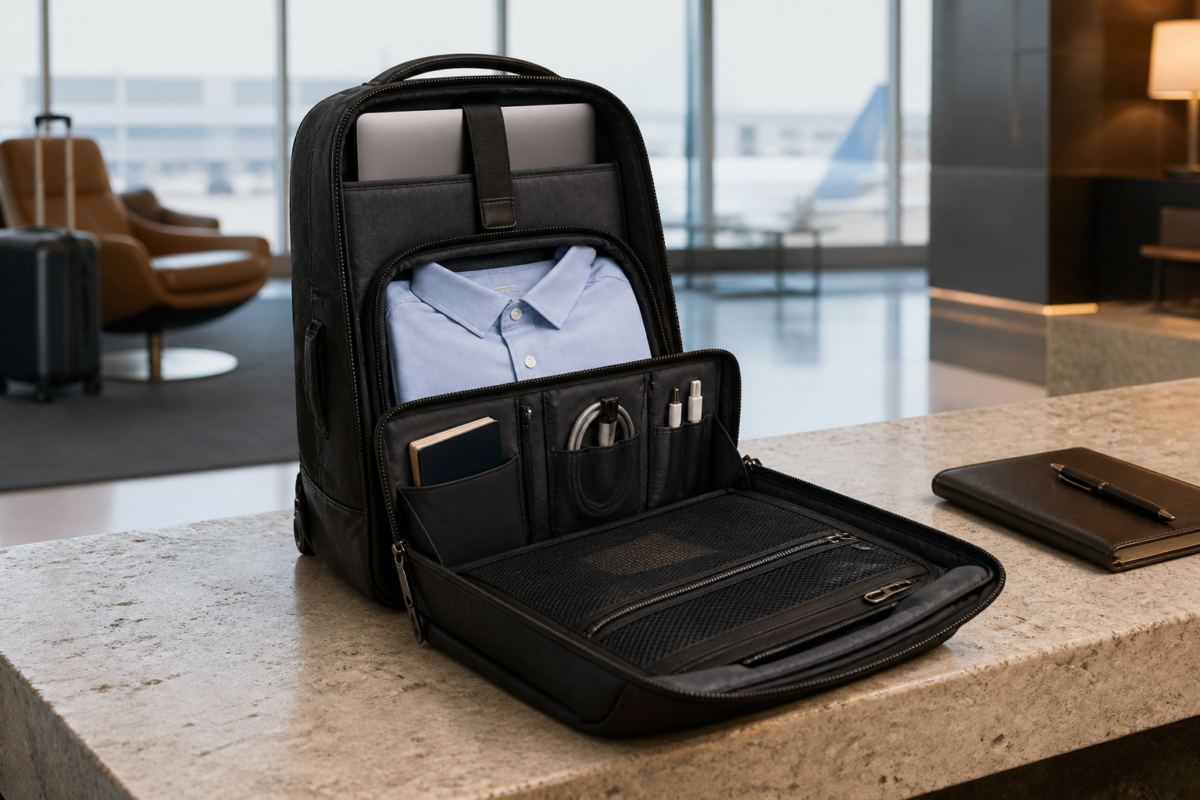
A compact cable and tech organiser. Put the laptop in a dedicated sleeve, chargers and cables in an organiser, and liquids in a clear zip pouch before he leaves the house. The Bellroy Tech Kit (around £50–£60) holds all cables flat and opens in one motion at the tray.
A clear 1-litre liquids bag. Required by most airports. Buy a proper resealable silicone bag rather than the disposable ones — he can reuse it indefinitely. Stasher bags or basic TSA-compliant pouches all work.
Laptop sleeve. If his laptop is in a sleeve rather than buried in a bag, it clears the security tray in seconds and goes back in cleanly. A quality leather sleeve from Pad & Quill or Knomo (around £60–£100) does the job and protects the machine.
A belt and shoes system. Not an accessory — a habit. Wearing shoes that slip off easily, and keeping a belt in the bag rather than wearing it, makes his security run noticeably faster than most people around him.
Phase 3: The terminal
Between security and boarding, the terminal is about staying productive, fed, and calm.
Noise-cancelling headphones. The most impactful terminal buy. Gate announcements, boarding chaos, children — all of it can be reduced to background hum. Sony WH-1000XM5 or Bose QuietComfort Ultra (around £280–£380) are the current benchmarks. See the best gifts for men who travel frequently for a full breakdown.
A portable battery pack. Airport USB charging points are consistently unreliable. A Zendure SuperMini (around £40–£55, 10,000mAh) charges his phone twice and fits in a jacket pocket. For the man who needs to charge a laptop, Anker 737 (around £80–£100, 24,000mAh, 140W) is the choice.
A refillable water bottle. Fill it after security. The Klean Kanteen TKPro 500ml (around £30–£40, insulated) keeps drinks cold for 20 hours. Avoids buying three bottles of overpriced water across the journey.
A quality pen. He’ll need to fill in an immigration card, sign a hotel document, or write something down at some point. Carrying a pen that doesn’t run out on the first form is a small and permanent improvement.
Phase 4: The flight
The flight is where most kit investments pay back most visibly.
Noise-cancelling headphones. The overhead cabin is loud. The difference between flying with and without proper ANC headphones is, for most frequent travellers, the most significant single quality-of-life upgrade available. Both Sony WH-1000XM5 and Bose QuietComfort Ultra are genuinely outstanding.
An eye mask and travel pillow (for long-haul). For short-haul, neither is necessary. For flights over six hours, a quality sleep mask — Alaska Bear Natural Silk (around £10–£15) or MZOO 3D Contour (around £20–£25) — and a compact travel pillow make the difference between landing rested and arriving wrecked.
A merino or cashmere layer. Cabin temperature on long-haul is cold and unpredictable. A lightweight merino zip or cashmere jersey in the bag replaces the complimentary airline blanket with something he actually wants to wear.
Good in-flight entertainment. Download offline content before he flies. Netflix, Spotify (downloaded), Audible, and a long-read — this isn’t a kit item, but it earns a mention because it’s the most commonly forgotten element of a long-haul preparation.
Phase 5: Landing and onward
The moment after landing is where poor preparation causes the most friction.
A multi-region travel adapter. Already important for the hotel room, but critical if he needs to charge at an international airport. The Zendure Passport III (around £40–£55) covers 200+ countries with USB-C PD. He buys it once, carries it forever.
Local currency and a cards-accepted backup. Cash for markets, cabs, and any location that doesn’t take card. Most major airports have currency exchange; his bank’s travel card (Starling, Wise, or Revolut) provides exchange-rate-efficient card spending without the 3% foreign transaction fee.
A TSA/Customs form pen. He’ll need it on the plane or at the gate. Already covered above, but worth re-emphasising for international travel.
The complete airport kit list
| Item |
Best pick |
Price |
| Carry bag |
Tumi or Bellroy (backpack) / Mismo or Filson (weekender) |
£150–£450 |
| Travel wallet |
Bellroy Travel Wallet |
£60–£80 |
| Packing cubes |
Peak Design or Eagle Creek |
£50–£80 |
| Luggage tag |
Aspinal or Ettinger (leather, monogrammed) |
£35–£55 |
| Cable organiser |
Bellroy Tech Kit |
£50–£60 |
| Noise-cancelling headphones |
Sony WH-1000XM5 |
£280–£320 |
| Portable battery |
Zendure SuperMini (day) / Anker 737 (laptop) |
£40–£100 |
| Water bottle |
Klean Kanteen TKPro 500ml |
£30–£40 |
| Travel adapter |
Zendure Passport III |
£40–£55 |
| Pen |
Lamy 2000 or Parker Jotter |
£15–£120 |
| Eye mask (long-haul) |
MZOO 3D Contour |
£20–£25 |
| Merino layer |
Uniqlo Merino or a cashmere zip |
£30–£120 |
The minimal viable airport kit (for occasional travellers)
If he only flies four or five times a year and doesn’t want to build a full kit, these three investments cover most of the friction:
1. Noise-cancelling headphones — the highest single-item impact. 2. A cable organiser — eliminates the tangled-cables problem permanently. 3. A quality leather luggage tag — small, permanent, makes the bag his.
Everything else can be added incrementally.
Frequently asked questions
What should you always have at the airport? Noise-cancelling headphones, a portable battery, a slim travel wallet, a cable organiser, a filled water bottle (after security), and a pen. These address the five most common friction points in every airport experience.
What’s the most important travel accessory for airports? Noise-cancelling headphones, consistently. They reduce terminal chaos, make the flight recoverable, and are used on every journey. The gap between mid-range and top-tier ANC (Sony XM5 or Bose QC Ultra) is significant.
What should I pack in my carry-on for a long-haul flight? Headphones, eye mask, a merino or cashmere layer, a portable battery, downloaded entertainment, and any medication. Long-haul comfort is about those six things, not gadgets.
How do I get through airport security faster? Wear slip-on shoes; put your belt in the bag; put your laptop in an accessible sleeve; put liquids in a clear pouch on top of the bag. Prepare the tray before you reach the belt. These five habits consistently put you through faster than most other travellers.
What’s the best bag for airport travel? A 24–28L carry-on backpack (for carry-on-only travel) or a 35–40L weekender. The backpack has the advantage of being hands-free through the terminal; the weekender handles better in overhead bins. Both should have a luggage pass-through for trips where he checks a roller case.
What travel accessories are worth the money? Noise-cancelling headphones, a quality cable organiser, packing cubes, a leather luggage tag, and a reliable multi-region travel adapter. All five are used on every trip, all improve the experience measurably, and all last years. See our full guide to travel accessories worth buying.
The bottom line
The best airport kit isn’t the one with the most gadgets — it’s the one that removes friction from every phase of the journey without adding bulk. A well-chosen set of headphones, an organised bag, a portable battery, and a slim travel wallet transform the airport experience from something to be endured into something that happens around him while he stays calm and comfortable. Build the kit once. Use it on every trip. Stop thinking about it.
Guide
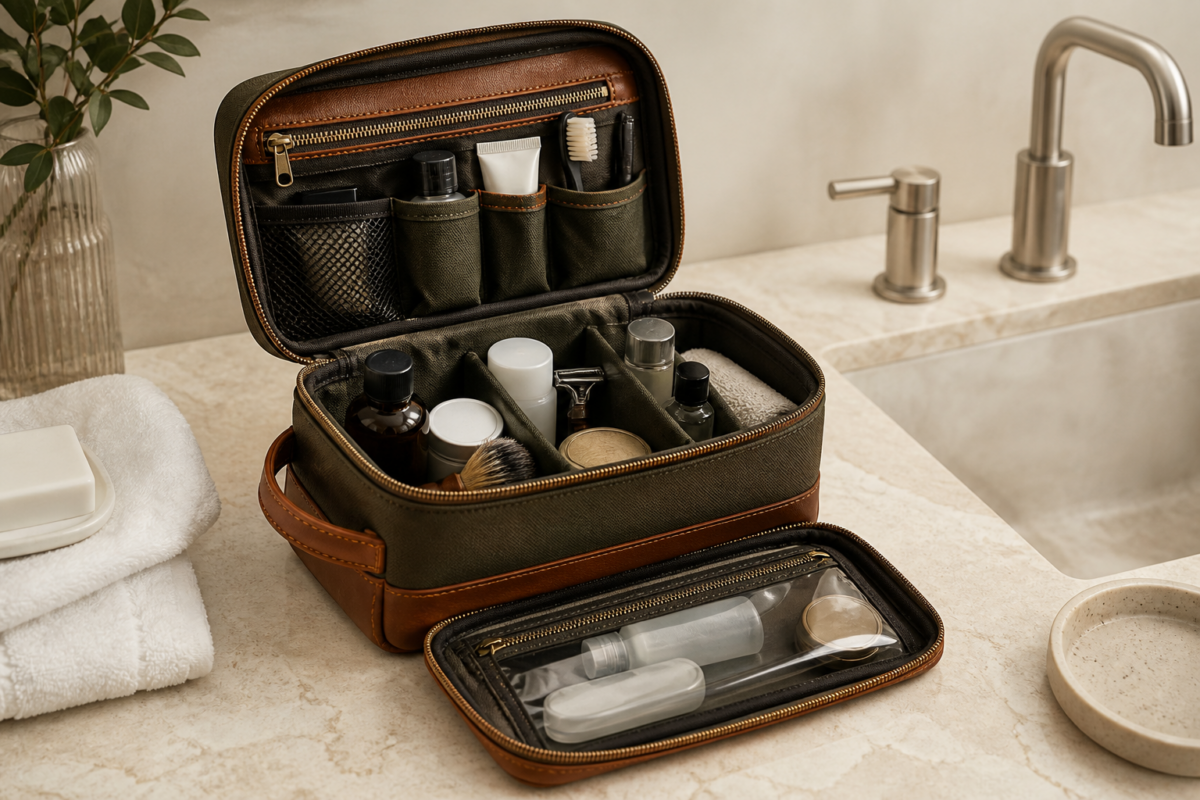
Best Toiletry Bags for Travel (Dopp Kits Worth Owning)
Last updated: June 2026
Quick answer: The best toiletry bags for travel are either a compact flat dopp kit in full-grain leather for hotel trips, or a hanging wash bag in leather or quality nylon for frequent hotel travel where he unpacks at the basin. The standout picks are the Mismo Travel Kit for the premium leather option, Bellroy Dopp Kit for the best value-to-quality ratio, and Ettinger Dopp Kit for British heritage leather. Avoid anything with too many pockets — a well-organised bag with three to four compartments is more useful than one with twenty.
This guide covers the formats, the materials, and the specific bags worth owning at each price point.
Why most men’s toiletry bags are worth upgrading
Most men travel with whatever complimentary wash bag came from the last hotel they stayed in, or a plastic-zip bag that’s been in the bathroom cupboard since 2018. A quality toiletry bag is one of the most-used travel objects — it comes out of the bag at every hotel, sits on the bathroom shelf, and goes back in every morning. The difference between using a properly made bag and a cheap one is felt every single day of the trip.
What matters most:
- Format first. A dopp kit (flat, unstructured) works well for one or two nights. A hanging wash bag is better for longer stays and small hotel bathrooms — you unzip it and hang it from the towel rail with everything visible.
- Size for his routine. Most travel kits need to hold: a razor, a moisturiser, a cleanser or wash, a toothbrush, deodorant, and any SPF or extras. A 4–6 litre capacity handles all of this; 2–3 litres is tight unless he travels very light.
- Material for longevity. Full-grain leather ages into a heritage piece. Waxed canvas is weather-resistant and rugged. Quality nylon is light and easy to clean. Cheap PVC or coated fabric looks bad quickly.
- Interior organisation. A waterproof lining is essential (spills happen). One or two internal pockets for small items, plus a main compartment for larger bottles.
The one-line rule: Choose the format for the type of trip you do most often (flat dopp for short trips, hanging bag for longer hotel stays), then buy the best material your budget allows — this is an object used on every trip.
The best toiletry bag formats
Format 1: Flat dopp kit / traditional case
The classic format. Sits flat on a bathroom shelf, zips around three sides, opens to reveal a single or divided interior. Best for one to three nights.
- Ettinger Bridle Hide Dopp Kit (around £120–£160): British bridle leather, brass hardware, robust zip, spacious interior. A possession rather than a travel product — will outlast twenty years of weekly travel.
- Mismo Travel Kit (around £200–£260): Swedish design, full-grain leather trim with a waxed canvas body, exceptional quality. The most visually striking dopp kit in the category.
- Bellroy Dopp Kit (around £70–£90): Australian brand, high-quality recycled nylon exterior, waterproof lining, magnetic closure, integrated hook. Outstanding value for a bag used on every trip.
- Aspinal of London Wash Bag (around £80–£120): Full-grain leather, monogrammable, clean interior. A strong gift option at this price.
- Montblanc Extreme 3.0 Travel Bag (around £200–£280): Premium coated canvas with leather trim, Montblanc’s quality hardware. The choice for the man who wants the brand.
Format 2: Hanging wash bag
Opens flat and hangs from a hook or towel rail, which is especially useful in hotel bathrooms where counter space is limited. Better for three-plus night trips.
- Mismo M/S Wash Bag (Hanging) (around £220–£280): The premium hanging option. Full-grain leather exterior with a waxed canvas interior, multiple pockets, strong hook. For the man who stays in hotels more than three nights at a time.
- Filson Rugged Twill Hanging Bag (around £100–£140): Rugged, American-made, straightforward organisation. For the man who wants durability over elegance.
- Osprey Ultralight Hanging Organiser (around £30–£45): Technical fabric, very light, functional organisation, good value. The practical choice for a man who packs light and doesn’t need premium aesthetics.
- Bellroy Hanging Toiletry Kit (around £80–£100): Quality nylon, waterproof lining, strong hook, organised pockets. The Bellroy standing recommendation for the hanging format.
- Kipling Defrost (around £40–£60): Affordable, water-resistant, wide-opening design. A competent everyday option.
Format 3: Small leather case / accessory pouch
For the ultra-minimalist traveller or the man who uses a hotel amenity kit and just needs to carry a razor, SPF, and medication.
- Ettinger Leather Accessory Pouch (around £60–£90): Small, British, quality leather zip. Holds the genuine essentials only.
- Smythson Panama Leather Zip Pouch (around £80–£120): A flat leather zip pouch in Smythson’s signature nappa. Clean, professional, minimal.
Toiletry bags at a glance
| Bag |
Format |
Material |
Best for |
Price |
| Ettinger Dopp Kit |
Flat |
Bridle leather |
Heritage, long ownership |
£120–£160 |
| Mismo Travel Kit |
Flat |
Canvas + leather |
Premium aesthetic |
£200–£260 |
| Bellroy Dopp Kit |
Flat |
Recycled nylon |
Best value |
£70–£90 |
| Mismo M/S Wash Bag |
Hanging |
Leather/canvas |
3+ night hotel trips |
£220–£280 |
| Bellroy Hanging Toiletry |
Hanging |
Quality nylon |
Value hanging option |
£80–£100 |
| Osprey Ultralight |
Hanging |
Technical fabric |
Minimalist, pack light |
£30–£45 |
Best pick by traveller type
| He is… |
Best toiletry bag |
| A frequent hotel traveller (3+ nights) |
Mismo M/S Wash Bag or Bellroy Hanging Toiletry Kit |
| Business travel, one to two nights |
Bellroy Dopp Kit or Aspinal Wash Bag |
| Wants the heritage leather piece |
Ettinger Bridle Hide Dopp Kit |
| Best value without compromising |
Bellroy Dopp Kit |
| Packs ultra-light, minimalist |
Osprey Ultralight Hanging Organiser |
| Looking for a gift |
Aspinal with monogram or Ettinger — both monogrammable |
How to choose in under a minute
1. How long are his typical trips? One to two nights: flat dopp kit. Three or more nights: hanging bag is more useful. 2. Does he care about leather vs. technical material? Leather: Ettinger or Mismo. Technical: Bellroy or Osprey. 3. Is this a gift? Add a monogram. Ettinger and Aspinal both offer monogramming on leather dopp kits. 4. What’s the budget? Under £100: Bellroy Dopp Kit. £100–£180: Ettinger. Over £180: Mismo.
Frequently asked questions
What is the best toiletry bag for travel? For hotel stays of two nights or less: the Bellroy Dopp Kit for value or the Ettinger Bridle Hide for quality. For longer stays: the Bellroy Hanging Toiletry Kit or the Mismo M/S Wash Bag. All four formats earn daily use and improve on whatever most men are currently travelling with.
What’s the difference between a dopp kit and a hanging wash bag? A dopp kit lies flat on a shelf or counter. A hanging wash bag opens flat and hangs from a hook or towel rail, which keeps everything visible and accessible without needing counter space. Hanging bags suit hotel and Airbnb travel better; dopp kits are simpler for shorter trips.
What should go in a travel toiletry bag? At minimum: razor or trimmer, moisturiser, cleanser, toothbrush and paste, deodorant, and any prescription medication. For longer trips: SPF, hair product, shaving cream. A 4–6 litre capacity handles all of this comfortably.
Are leather toiletry bags worth it? For frequent travellers, yes. Full-grain leather ages well, holds shape over decades of use, and looks significantly better than the alternatives. The Ettinger Dopp Kit at £120–£160 will outlast five or six mid-range alternatives. The cost-per-trip argument is strong.
What’s the best toiletry bag as a gift? A monogrammed leather dopp kit from Ettinger or Aspinal of London. Both offer personalisation, both are immediately recognisable as quality, and both are the kind of object he’ll use on every trip for years. A toiletry bag is one of the most consistently well-received gift categories in this space.
How do I stop liquids leaking in a toiletry bag? Use 100ml travel bottles and store anything with a liquid cap facing up. A waterproof lining (present in most quality bags) contains minor leaks. For added protection, keep liquids in a separate zip pouch inside the bag.
The bottom line
A quality toiletry bag is one of the most-used travel objects a man owns — it comes out on every trip, sits on the hotel shelf every morning, and goes back in the bag every checkout. Most men travel with something they’ve had for years without thinking to upgrade it. A properly made leather dopp kit or hanging wash bag costs between £70 and £200, lasts twenty years, and is noticeably better every single time it’s used. Buy once, carry forever.
Guide
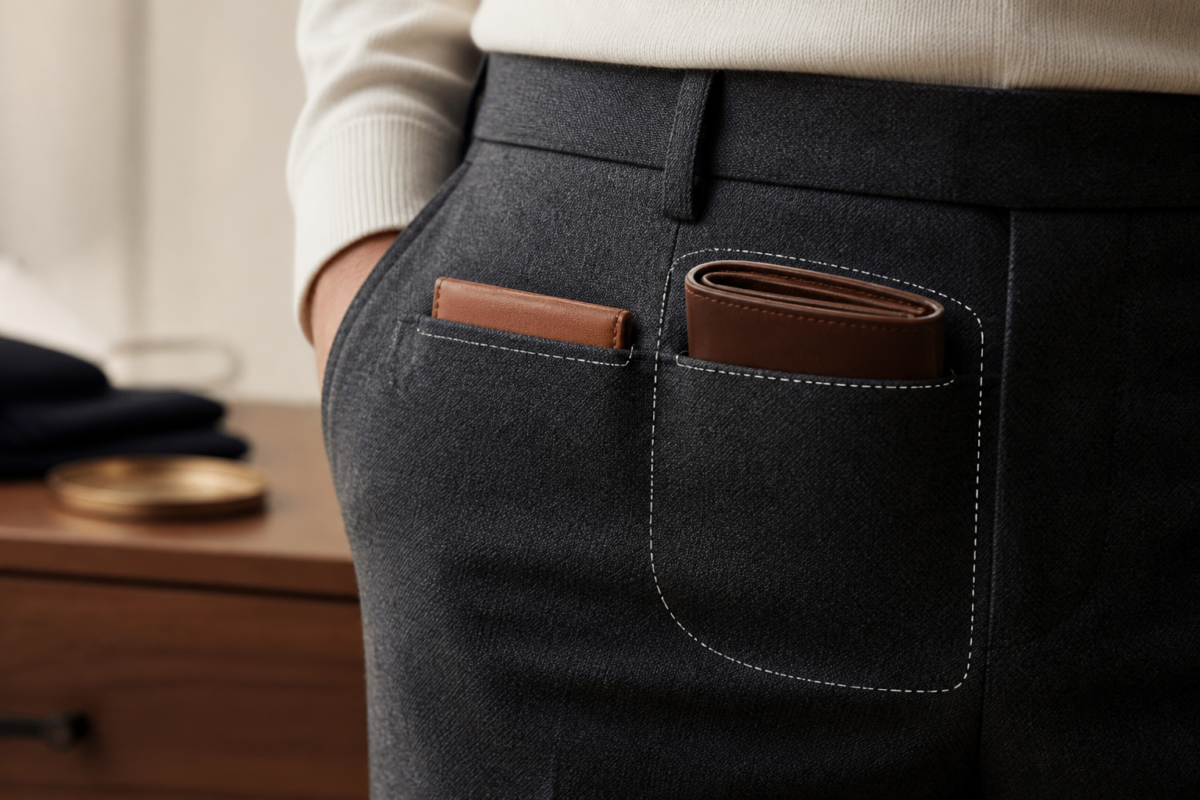
Best Minimalist Wallets for Men (That Actually Fit in Your Pocket)
Last updated: June 2026
Quick answer: The best minimalist wallets for men hold four to eight cards, are under 8mm when empty, and are made from full-grain leather, titanium, or quality technical fabric. The standout picks are the Bellroy Note Sleeve for the leather-and-function buyer, the Secrid Slim Wallet for RFID-blocking with quick card access, and the Ekster Parliament for the man who wants slim plus AirTag tracking. The bifold is over. Buy thin.
This guide covers every minimalist wallet format — slim leather, aluminium card-slider, hybrid, and card case — with specific recommendations and a decision table.
Why the bifold wallet is the wrong choice
The traditional bifold wallet was designed for a world of cash and paper receipts. Most men who carry one have more cards than slots, stuff receipts in every pocket until it’s thicker than a phone, and then shove it into a back pocket where it sits all day. The data shows the average man carries only three to five cards regularly. A properly chosen slim wallet holds that, plus some cash, in a fraction of the space.
What a minimalist wallet does differently:
- Card capacity matched to actual use. Four to eight slots for the cards he actually carries, not twelve for the ones he never uses.
- Slim profile. Under 8mm when loaded. The difference between a slim wallet in a front trouser pocket and a traditional bifold in the back is felt immediately.
- Quality construction. Without a leather interior to pad it, every material decision shows. A minimalist wallet has nowhere to hide poor stitching or cheap leather.
The one-line rule: Count how many cards you actually use daily, buy a wallet with that plus one slot, and your pocket will never bulge again.
The four formats of minimalist wallet
1. Slim leather bifold and cardholders (the classic upgrade)
A slim leather wallet keeps the familiar bifold shape but removes everything unnecessary. The key difference from a traditional bifold: under 6mm when loaded, fewer slots, cleaner construction.
- Bellroy Note Sleeve (around £60–£80): The most-recommended slim leather wallet in the category. Holds 4–8 cards, a bill note slot, slim profile, outstanding leather quality. The right choice for the man who wants the traditional wallet experience, made properly.
- Bellroy Slim Sleeve (around £50–£70): Slightly slimmer than the Note Sleeve. Holds 4–8 cards without the bill note slot. The most minimal leather option in the Bellroy range.
- Ettinger Sterling Cardholder (around £55–£75): British bridle leather, four card slots, flat profile. Excellent daily carry choice for the man who values heritage leather.
- Smythson Mara Folded Card Case (around £125–£160): A slim London-made leather cardholder with a clean, understated aesthetic. The right choice for a professional environment or as a premium gift.
2. Aluminium card-slider wallets (the functional choice)
The card-slider wallet adds a mechanism to the slim wallet concept: press a lever and cards fan out for access. Adds RFID blocking as a default.
- Secrid Slim Wallet (around £60–£80): The category benchmark. A small metal box that holds 6 cards in the slider plus 2 more in the leather sleeve. RFID-blocking aluminium, immediate one-hand card access, fits front trouser pocket flat. The most copied wallet concept on the market.
- Secrid Mini Wallet (around £55–£75): Same mechanism, shorter sleeve, fewer secondary cards. The option for the ultra-minimalist packer.
- Ekster Parliament (around £70–£90): Adds a hidden tracker slot for an Ekster tracker card or a Tile card — or can be converted for an AirTag slim card. Very good build quality, fast card access.
- Dango D01 Dapper (around £55–£80): US-made aircraft aluminium, similar card-slider principle, modular so he can add a cash strap or phone mount.
3. Card case (the truly minimal option)
For the man who uses Apple Pay for most transactions and only needs two to four cards accessible, a simple card case is the most minimal option.
- Valextra Milano Card Case (around £150–£200): Italian premium craftsmanship, clean design, full-grain calfskin. The finest quality in the card case category. A possession, not just an accessory.
- Aspinal of London Saffiano Card Case (around £50–£80): Accessible luxury, monogrammable, clean aesthetic. Good gift choice.
- Montblanc Meisterstück Card Holder (around £110–£140): A well-constructed card case from the pen brand. Works well as a companion to a Montblanc pen for a complete EDC gift.
4. Hybrid tech wallets (the modern carry option)
A small category but growing: wallets that integrate tracking, wireless charging, or phone attachment.
- Ekster Senate Cardholder with Tracker (around £80–£110): Built-in solar-powered tracker (Google Find My compatible), fast card access, slim leather body. The choice for the man who regularly loses his wallet.
- Peak Design Mobile Wallet (around £30–£40): A card holder that attaches to the back of a Peak Design phone case via MagSafe-compatible magnets. The most minimal option for iPhone users already in the Peak Design ecosystem.
Minimalist wallets at a glance
| Wallet |
Format |
Capacity |
RFID |
Price |
| Bellroy Note Sleeve |
Slim leather |
4–8 cards + bills |
No |
£60–£80 |
| Secrid Slim Wallet |
Card-slider |
6+2 cards |
Yes |
£60–£80 |
| Ekster Parliament |
Card-slider + tracker |
6+2 cards |
Yes |
£70–£90 |
| Ettinger Sterling |
Cardholder |
4 cards |
No |
£55–£75 |
| Valextra Card Case |
Card case |
4–6 cards |
No |
£150–£200 |
| Ekster Senate |
Tracked cardholder |
4–6 cards |
Yes |
£80–£110 |
Best pick by priority
| He prioritises… |
Best wallet |
| Leather quality and heritage |
Ettinger Sterling or Valextra Card Case |
| Best all-round slim wallet |
Bellroy Note Sleeve |
| RFID protection + fast card access |
Secrid Slim Wallet |
| Tracking built in |
Ekster Senate or Parliament |
| Premium gift, clean aesthetic |
Smythson Card Case or Montblanc Cardholder |
| iPhone user, integrated ecosystem |
Peak Design Mobile Wallet |
How to choose in under a minute
1. How many cards does he actually carry daily? Under 4: a card case is enough. 4–6: Secrid or Bellroy Slim Sleeve. 6–8: Bellroy Note Sleeve. 2. Does he carry cash regularly? If yes: Bellroy Note Sleeve. If no: a card case or Secrid is simpler. 3. Does he lose his wallet? Ekster Senate or Parliament with a built-in tracker. 4. What’s the budget? Under £70: Secrid or Ettinger. £70–£120: Ekster or Bellroy. Over £120: Valextra or Smythson.
Frequently asked questions
What is the best minimalist wallet for men? The Bellroy Note Sleeve for the man who wants the best slim leather wallet with room for cards and cash. The Secrid Slim Wallet for RFID protection and the fastest card access. Both are outstanding everyday carry choices.
What is the slimmest wallet for men? The Secrid Mini Wallet and the Valextra Card Case are among the slimmest. The Secrid with its aluminium core is under 8mm fully loaded; the Valextra card case is a few millimetres of leather with room for four cards.
Are minimalist wallets worth it? Yes, for almost any man who currently carries a bulging bifold. The switch to a slim wallet is an immediate quality-of-life improvement: lighter pocket, faster access, no receipt mountain building up. Most men who make the switch wonder what took them so long.
What’s the difference between Secrid and Bellroy? Secrid uses an aluminium card-slider mechanism with a leather sleeve — RFID blocking, fast access, very slim. Bellroy uses a traditional leather format made thinner — softer feel, more traditional wallet experience, no slider mechanism. Both are excellent; the choice is format preference.
Do minimalist wallets hold cash? Card cases and Secrid without a sleeve do not hold cash well. The Bellroy Note Sleeve has a dedicated bill slot. Some Secrid models have a leather sleeve that holds folded notes. If he regularly carries cash, the Bellroy Note Sleeve is the better choice.
What’s the best wallet as a gift for a man? An Ettinger Sterling cardholder (monogrammable, British heritage, under £80) or a Bellroy Note Sleeve (outstanding quality, clean aesthetic). Both are daily-use gifts that feel considered and improve his life immediately.
The bottom line
The bifold wallet is the last piece of daily carry most men modernise — and the difference when they do is immediate. A slim, quality cardholder or card-slider holds everything he actually needs, fits flat in a front pocket, and improves every time he uses it. At £60–£100, it’s one of the highest-value daily-carry upgrades available: bought once, used every day, never regretted.
Guide
Best Premium Everyday Carry Essentials for Men
Last updated: June 2026
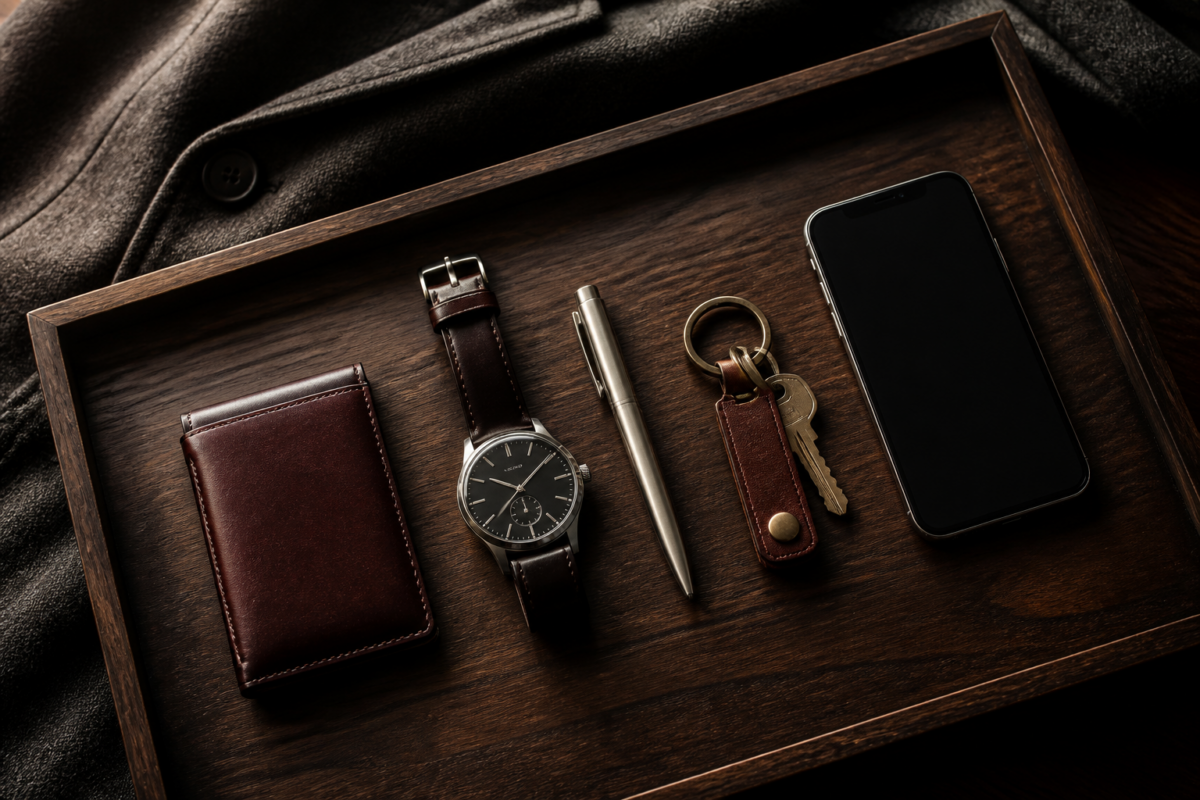
Quick answer: The best premium everyday carry (EDC) setup is built around five essentials: a quality wallet or cardholder, a well-chosen watch, a reliable pen, a key organiser or holder, and a phone case worth owning. Beyond those, a notebook, a pocket multi-tool, and a quality lighter or canister complete the picture. The principle is the same across all of them: buy the best version of the thing you use every single day, and buy it once.
This guide covers each EDC category, what separates good from great, and the specific options worth knowing.
What everyday carry actually means
Everyday carry is everything a man has on him, every day, without thinking about it. His wallet, his keys, his phone, his watch, his pen. These are the objects he reaches for dozens of times a day and has carried in the same form for years — often not because they’re the best option, but because replacing them was never a priority.
The premise of premium EDC is simple: if you’re going to carry something every single day for the next decade, it’s worth spending time choosing the right version. The best wallet costs six times the worst one and lasts thirty years. The difference in daily experience is significant.
The one-line rule: The daily-carry objects are the ones most worth getting right — if you’re going to carry something every day, carry the best version of it.
The five everyday carry essentials
1. The wallet (the most replaced EDC item)
The wallet is the single most common daily-carry upgrade, because most men have one that’s too thick, too worn, or too generic. The modern premium wallet is slim, full-grain leather, and carries four to eight cards plus some cash.
What to look for:
- Full-grain leather (not top-grain or bonded)
- Five to eight card slots or a card sleeve
- Vegetable-tanned or bridle leather for the best ageing
- Monogram option if you want personalisation
The best wallets:
- Ettinger Sterling Card Case (around £55–£75): British bridle leather, four card slots, sharp colour options. The right choice if he values heritage and patina.
- Bellroy Note Sleeve (around £60–£80): Outstanding organisation, slim design, Australian brand. The modern daily-carry wallet.
- Valextra Card Case (around £150–£200): Italian premium, impeccable construction, minimal branding. The finest construction in the category.
- Secrid Slim Wallet (around £60–£80): Aluminium card-slider mechanism, compact, RFID blocking. For the man who prefers function over leather.
2. The watch (the daily-carry piece that matters most)
A watch is the one daily accessory that tells the room something about you. The right watch at the right price level communicates taste, not wealth.
What to look for:
- A reliable automatic or high-quality quartz movement
- A case diameter that suits his wrist (36–40mm for most)
- A dial and strap combination that works with his wardrobe
- A maker with a genuine watchmaking heritage
The best options at different price points:
- Seiko Presage (around £400–£700): Japanese craftsmanship, beautiful enamel and lacquer dials, automatic movement. Outstanding quality-to-price.
- Hamilton Khaki Field (around £400–£550): Military-inspired, robust, clean dial. The everyday mechanical watch for the practical dresser.
- Longines Heritage (around £800–£1,400): Swiss heritage, dress-watch credentials, outstanding movements at the price.
- Omega Seamaster or Constellation (around £3,000–£5,000): The premium everyday watch. Exceptional movement, brand heritage, long-term value.
- A.Lange & Söhne or IWC (above £5,000): For the watch person who invests seriously.
3. The pen (used more than most men admit)
Men who carry a quality pen use it every day. Most men carry nothing and borrow pens when needed. The gap between the two experiences is considerable.
What to look for:
- A refillable mechanism (rollerball, fountain, or ballpoint)
- A weight and balance that suits his grip
- A finish that ages rather than wears out
The best pens:
- Lamy 2000 (around £100–£120): Iconic German design, outstanding writing feel, brushed steel body. The design-minded pen choice.
- Parker Jotter All-Steel (around £15–£25): The underrated EDC ballpoint. Reliable, slim, refillable, quarter the price of most premium alternatives.
- Montblanc Meisterstück 149 (around £600–£700): The status pen. Outstanding construction, iconic design, the choice for milestone gifts or serious collectors.
- TWSBI Eco Fountain Pen (around £25–£35): Excellent entry into fountain pens. The best pen under £50 for someone new to the category.
4. Key organiser (the upgrade that removes daily frustration)
Most men carry their keys in a pocket where they jangle, scratch the phone, and bulk everything out. A key organiser solves this permanently.
What to look for:
- A capacity that fits his key count
- A locking mechanism that prevents accidental extension
- Material (leather vs. titanium vs. steel) that suits his aesthetic
The best key organisers:
- Orbitkey Key Organiser (around £30–£45): The category benchmark. Leather strap with riveted key slots, up to 7 keys, accessible with one hand. Slim, silent, robust.
- Bellroy Key Cover (around £25–£35): Softer leather wrap format, easier daily access, smaller key count.
- Ekster Key Holder (around £35–£50): Aluminium case, spring-loaded access, works with AirTag. The modern alternative to leather formats.
- KeyBar (around £40–£60): Anodised aluminium, titanium option available, machined quality. For the man who prefers a technical aesthetic.
5. The phone case (the item most men underinvest in)
A phone is the most-handled object in any man’s pocket. A quality case protects a £1,000 piece of hardware and is worth more than most men spend on it.
What to look for:
- Protection proportionate to how he handles his phone
- A material that ages or holds up under daily handling
- MagSafe compatibility for iPhone users (2020 onwards)
The best phone cases:
- Nomad Leather Case (around £40–£60): Horween leather from Chicago, ages beautifully, MagSafe compatible. The EDC leather case benchmark.
- Peak Design Everyday Case (around £70–£90): Outstanding protection, modular mounting system, slim. The functional benchmark.
- Apple MagSafe Silicone Case (around £45–£55): The clean minimal option. Official Apple quality, good protection, works seamlessly with MagSafe accessories.
- Casetify Impact Case (around £40–£55): Best-in-category drop protection. Customisable, limited-edition collabs with quality designers.
Secondary EDC worth adding
- Notebook: Field Notes (around £10–£15) or Leuchtturm1917 Pocket (around £12–£18) for the man who still writes by hand. More useful than most phone apps for quick capture.
- Pocket multi-tool: Leatherman Squirt PS4 (around £30–£40) or Victorinox Classic SD (around £20–£30). Genuinely useful; the compact version fits in a key chain.
- AirTag or tracking tile: An AirTag (around £29) on his keys and bag ends the “where did I put it” loop permanently. Leather AirTag holders from Ettinger or Nomad are worth buying alongside.
- Card case: For men who prefer cards separate from their wallet — a slim card case from Valextra or Aspinal sits in a jacket pocket for nights out.
Best EDC pick by man
| He is… |
First EDC upgrade |
| Carries too many cards |
Bellroy Note Sleeve or Secrid Slim Wallet |
| Doesn’t own a quality watch |
Seiko Presage or Hamilton Khaki Field |
| Always borrowing pens |
Lamy 2000 or Montblanc Meisterstück |
| Keys always scratching his phone |
Orbitkey Key Organiser |
| Phone case is cracked or non-existent |
Nomad Leather Case or Peak Design |
| Wants to start from scratch |
Ettinger wallet + Orbitkey + Seiko Presage |
How to build an EDC kit upgrade
1. Start with the highest-frequency item. What does he reach for most? Wallet: upgrade the wallet first. Keys: start with the Orbitkey. 2. Go one item at a time. A full EDC upgrade as a gift can feel overwhelming. Choose the item that’ll have the most daily impact. 3. Buy once, buy right. At this level, there’s no second-best — the Lamy 2000 is better than three cheaper pens combined.
Frequently asked questions
What is everyday carry (EDC)? Everyday carry is the set of objects a man has on him every day: wallet, keys, phone, watch, pen. Premium EDC is the practice of choosing the best version of each of those objects, on the basis that things used every day are worth getting right.
What’s the most important EDC upgrade? The wallet, for most men. It’s the item with the most room for improvement (most men use cheap, overstuffed wallets) and the highest daily-use frequency. A slim, full-grain leather wallet is an immediate and permanent improvement.
What’s a good EDC gift for a man? An Orbitkey key organiser, a quality pen (Lamy 2000 or Parker Jotter), a full-grain leather wallet, or a Nomad leather phone case. All sit under £100, earn daily use, and are upgrades most men wouldn’t buy for themselves.
Are expensive wallets worth it? Yes — for men who carry a wallet daily. A full-grain leather wallet at £60–£100 will last ten years or more, age significantly better than synthetic or top-grain alternatives, and feel meaningfully nicer every time you open it. The cost-per-use argument is strong.
What EDC items do most men underinvest in? The pen (most men carry nothing), the key organiser (most men have loose keys scratching everything in their pocket), and the phone case (most men either have no case or a cheap one on a £1,000 phone). All three are easy and relatively inexpensive upgrades.
What watch is best for everyday carry? For most budgets, a Seiko Presage or Hamilton Khaki Field at £400–£600 gives outstanding quality, reliable movement, and a design that works with most wardrobes. For higher budgets, Longines Heritage or Omega Seamaster are the step-up.
The bottom line
Everyday carry objects are the ones most worth upgrading precisely because they’re used constantly. A better wallet, a quality pen, a key organiser that doesn’t scratch everything, and a phone case worth owning make a tangible difference to the daily experience of getting dressed and leaving the house. Buy the best version of each one and stop thinking about them — which is exactly what good everyday carry should do.
Guide
Best Travel Accessories Worth Buying (And the Ones to Skip)
Last updated: June 2026
Quick answer: The travel accessories worth buying are the ones that solve a real problem he has on every trip: a quality multi-region adapter, a flat cable organiser, a slim travel wallet, a leather luggage tag, and compression packing cubes. The ones to skip are anything designed for a single scenario (the packing “hacks” you use once), overly large organisers that add bulk, and novelty travel gadgets that looked useful in a YouTube video. The rule is simple: if he’d reach for it on every trip, buy the best version. If not, skip it.
This guide covers the accessories that genuinely earn their place in a travel kit, with specific recommendations in each category.
The case for accessorising a travel kit properly
Most men have a functional-but-chaotic travel kit: cables loose in a side pocket, adapters from three different countries floating in a bag, passport crammed into a wallet that’s too small. The right accessories remove this friction permanently.
The criteria for an accessory worth buying:
- He uses it on every single trip. Not the camping trip or the ski holiday — on every trip he takes.
- It solves a specific problem he actually has. Lost cables, dead batteries, overstuffed bags, bag-check anxiety.
- It’s better than his current solution. Not marginally — noticeably.
The one-line rule: Every accessory should solve a real problem, look good doing it, and earn its place on every trip — if it misses any of those three, it’s clutter.
The travel accessories worth owning
1. Cable and charger organiser (highest immediate impact)
The single highest-friction area in most men’s travel kits is cables. A flat-lay organiser removes the untangling ritual permanently.
- Bellroy Tech Kit (around £50–£60): The benchmark tech organiser. Opens flat, elastic loops for cables, dedicated slots for small chargers and earbuds, internal zipper for SD cards or SIMs. Compact enough for a jacket pocket, organised enough to replace the bottom-of-bag chaos.
- Ekster Cable Organiser (around £35–£45): Slightly slimmer than the Bellroy, high-quality zipper, well-sized for one laptop charger + 2–3 cables.
- Knomo Cable Organiser (around £25–£35): More affordable entry into the category. Good enough for the occasional traveller who doesn’t need premium.
2. Multi-region travel adapter (a small thing that matters a lot)
A cheap adapter breaks. A good adapter outlasts a decade of travel.
- Zendure Passport III (around £40–£55): 4 USB-A + 1 USB-C, 65W, coverage for 200+ countries, compact form factor, no grounding adapter needed. The current benchmark.
- Belkin Travel Adapter (around £30–£45): Reliable, widely available, Belkin’s quality control is consistent. Good for the traveller who wants a brand he trusts.
- Native Union Travel Adapter (around £35–£50): Premium aesthetic, fewer USB ports, better suited to the design-conscious packer.
3. Leather luggage tag (the most overlooked upgrade)
At most airports, luggage tags are either plastic from the airline or a paper receipt slipped into a plastic sleeve. A full-grain leather tag costs under £60 and lasts twenty years.
- Aspinal of London Luggage Tag (around £35–£55): Clean, British, monogrammable, full-grain leather. The standard recommendation.
- Ettinger Leather Tag (around £30–£50): Heritage British brand, bridle leather option, brass hardware.
- AirTag leather holder (around £30–£55): Combines a luggage tag with an Apple AirTag slot. Multiple leather-goods makers now make these; search for full-grain leather rather than bonded.
4. Packing cubes (worth the investment for carry-on travel)
The gap between using packing cubes and not using them is larger than most people expect until they try them.
- Bellroy Packable Tote Set (around £40–£60): Lightweight, compresses well, comes in useful sizes. Good for the minimalist packer.
- Peak Design Packing Cubes (around £50–£80/set): Outstanding construction, flat when empty, standard and half-size available. The premium option for frequent travellers.
- Eagle Creek Pack-It Specter Compression (around £25–£40 each): The compression mechanism adds meaningful extra volume in the same bag. Popular with carry-on-only travellers.
- CALPAK Terrazzo (around £35–£50/set): Strong aesthetic, well-made, three-size sets cover most trips.
5. Slim travel wallet or document organiser
Carrying a passport plus multiple cards plus travel insurance in different pockets is avoidable. A slim travel wallet organises all of it.
- Bellroy Travel Wallet (around £60–£80): Slim, holds passport + cards + note + SIM cards. The right size for business travel without the overstuffed zip-around look.
- Smythson Panama Zip Travel Wallet (around £150–£200): Premium leather, British brand, room for passport, cards, currency. The standout choice for the quality-focused traveller.
- Secrid RFID Slim Wallet (around £60–£80): Metal RFID sleeve for cards, slimmer than most, good for the minimal packer.
6. Portable battery / power bank
The travel accessory he’ll miss most if he doesn’t have it.
- Anker 737 Power Bank (around £80–£100): 24,000mAh, 140W max output, charges laptops. The choice for long-haul and remote travel.
- Anker 622 Magnetic Battery (around £35–£45): Slim, MagSafe-compatible (iPhone), pocketable. Best for urban or one-day travel where a phone top-up is enough.
- Zendure SuperMini (around £40–£55): The smallest high-capacity option. 10,000mAh in a palm-sized form.
7. Noise-cancelling headphones
Worth its own category. See the travel gift guide for full detail — but if he’s travelling more than twice a month without top-tier ANC headphones, that’s the accessory with the highest impact.
Travel accessories to skip (or buy carefully)
- Travel pillow neck cushions: Most high-quality ones are bulky; most compact ones don’t work. Only worth it for very regular long-haul. Trtl Pillow is the compact exception.
- Travel locks and cables: Only needed for hostels or extended checked luggage. A TSA-approved padlock is enough.
- Travel wallets with 40+ card slots: Bulk creates more problem than the organisation solves. Aim for the slimmest wallet that fits the essentials.
- In-flight compression socks (on medical advice only): If a doctor recommends them, buy them — if not, they’re often unnecessary.
- Universal remote locks: Almost never used. If he’s travelling to places that warrant one, he’ll know.
Best pick by friction point
| Problem |
Best accessory |
| Cables always tangled |
Bellroy Tech Kit |
| Always running out of adapters |
Zendure Passport III |
| Bag always overstuffed |
Peak Design or Eagle Creek packing cubes |
| Passport always in wrong pocket |
Bellroy Travel Wallet |
| Phone always dying at the airport |
Anker 622 Magnetic Battery |
| Luggage looks like everyone else’s |
Leather luggage tag, monogrammed |
How to choose in under a minute
1. What’s the biggest friction point in his current travel kit? Start there, not with what looks impressive. 2. Does he travel carry-on or checked? Carry-on: packing cubes are the highest-impact buy. Checked: a quality luggage tag matters more. 3. Does he have good headphones? If not, that’s the accessory with the largest day-to-day impact. 4. What’s his adapter situation? A good multi-region adapter with USB-C PD is worth owning regardless of how frequently he travels.
Frequently asked questions
What are the best travel accessories for men? A quality cable organiser (Bellroy Tech Kit), a multi-region adapter (Zendure Passport III), packing cubes (Peak Design), a slim travel wallet, and a leather luggage tag. These are the five accessories that earn use on every trip and make the biggest difference to a chaotic travel kit.
Are packing cubes worth it? Yes — for carry-on travellers especially. A good set of cubes makes a carry-on bag hold more, stay organised between locations, and unpack faster at the hotel. The difference is immediately obvious once you use them properly.
What’s the best travel adapter for Europe and the US? The Zendure Passport III covers both and most other destinations, with USB-C PD and multiple USB-A ports in a compact form. It’s the standout recommendation at under £55.
What’s a good travel accessory under £50? A leather luggage tag (around £35–£50), a cable organiser (around £35–£45), or a single compression packing cube (around £25–£40). All three earn daily use on every trip.
What travel accessories do frequent business travellers swear by? In order of consistency: noise-cancelling headphones, a cable organiser, packing cubes, a quality travel adapter, and a slim travel wallet. These five address the five most common friction points in business travel.
Are travel gadgets worth buying? Rarely. Most travel gadgets solve a problem that comes up infrequently (a universal remote lock, a water purification bottle, a rain poncho that packs to nothing) or duplicate something he already has on his phone. The accessories worth buying are the boring, daily-use ones — the cables, the cubes, the adapters.
The bottom line
The best travel accessories are the ones that remove friction on every trip, not the ones that solve edge-case problems or look impressive in a flat-lay. A good cable organiser, a reliable adapter, quality packing cubes, a slim travel wallet, and a leather luggage tag will make every trip meaningfully smoother. Buy the best version of each. Skip anything that won’t earn its keep on the next ten trips.
Guide
Best Weekender Bags for Men (That Work for One Night to Three)
Last updated: June 2026
Quick answer: The best weekender bags for men are 30–45L, carry enough for two nights without looking like luggage, and are built from materials — leather, waxed canvas, ballistic nylon — that age well and look intentional alongside a good outfit. The standout picks are the Mismo M/S Weekender for leather, the Filson Duffle Medium for waxed canvas, and the Bellroy Venture Duffel 40L for the modern technical option. Buy for the trip length you actually do, not the longest one you might.
This guide covers what to look for, the best bags in each material, and how to match a bag to his travel habits.
What makes a great weekender bag
A weekender bag sits between a day bag and proper luggage — it needs to carry enough for two nights without looking like a suitcase, travel well by hand or over a shoulder, and hold up to repeated use without looking beaten. The wrong size is the most common mistake: go too small and it won’t fit everything; go too large and it becomes checked luggage.
What to prioritise:
- 30–40L is the sweet spot. Under 30L works for one night only. Over 45L is a proper holdall and usually too large for cabin carry. For most two-night trips, 35–40L with good compression is perfect.
- Material defines the character. Full-grain leather ages into a heritage piece. Waxed canvas is rugged and weather-resistant. Ballistic nylon is durable and travels lighter. Technical fabrics are the lightest but least characterful.
- Carry comfort matters. A shoulder strap is essential for airport or station travel. Grab handles need reinforced stitching. Some bags have hidden backpack straps — useful for hands-free travel.
- Interior organisation. A shoe compartment, a wet/dry pocket, and at least one internal organiser matter for trips where he’s dressing for different occasions.
- Luggage pass-through. A sleeve or strap that fits over a roller handle is useful if he travels with a carry-on as well.
The one-line rule: Buy the size for the trips you actually do, in the material that suits your life — a beautiful leather weekender you never use because it’s too small is no use to anyone.
The best weekender bags by material
Full-grain leather (the heritage option)
Leather weekenders are the most visually striking and the best-ageing choice. They require care, are heavier, and cost more — but a well-made leather duffel can be a possession for twenty years.
- Mismo M/S Weekender (around £380–£450): The benchmark for modern leather weekenders. Swedish design, full-grain leather handles and trim with a waxed canvas body, clean interior, reinforced base. The bag that looks as good in the hotel lobby as it does in the overhead bin.
- Ettinger Bridle Hide Cabin Bag (around £450–£600): British heritage, full-grain bridle leather, hand-stitched detailing. A bag with genuine provenance that ages spectacularly.
- Saddleback Leather Duffel (around £350–£500): American full-grain leather, extremely rugged construction, 100-year guarantee. Heavy, but essentially indestructible.
- Brunello Cucinelli or Valextra (£800+): For the buyer with no upper limit, Italian-crafted luxury leather holdalls from these houses are exceptional.
Waxed canvas (the rugged option)
Waxed canvas combines the visual warmth of a heritage material with genuine weather resistance and lighter weight than leather. It’s the choice for men who want a classic aesthetic without the fragility.
- Filson Medium Duffle (around £300–£360): The definitive waxed canvas weekender. Rugged, water-resistant, outsized capacity for its footprint, brass zips, and Filson’s twill lining. It gets better with age and hard use.
- Barbour Wax Holdall (around £100–£160): More accessible price, distinctly British aesthetic, genuine waxed cotton that reproof. Good choice for the man who travels in inclement weather.
- Bennett Winch Canvas Weekend Bag (around £400–£500): British-made, luxury waxed canvas, excellent organisation. Made in England; a premium alternative to Filson.
Ballistic nylon and technical fabric (the functional option)
For frequent travellers who prioritise performance over aesthetics, ballistic nylon and technical fabrics offer the best durability-to-weight ratio.
- Tumi Alpha Bravo Knox Duffel (around £400–£450): Tumi’s signature ballistic nylon, excellent organisation, luggage pass-through, polished hardware. The business travel choice.
- Bellroy Venture Duffel 40L (around £190–£230): Outstanding organisation, recycled nylon construction, shoe compartment, compression straps, luggage pass-through. The best-value functional weekender on the market.
- Patagonia Black Hole Duffel 40L (around £130–£160): Technical fabric, waterproof zip options, converts to backpack. The outdoor-adjacent choice for the man who needs durability over style.
Weekender bags at a glance
| Bag |
Material |
Capacity |
Best for |
Price |
| Mismo M/S Weekender |
Waxed canvas + leather |
35L |
Aesthetic, hotel trips |
£380–£450 |
| Filson Medium Duffle |
Waxed canvas |
42L |
Rugged travel, outdoors |
£300–£360 |
| Ettinger Cabin Bag |
Bridle leather |
30L |
British heritage, short trips |
£450–£600 |
| Tumi Knox Duffel |
Ballistic nylon |
40L |
Business travel |
£400–£450 |
| Bellroy Venture 40L |
Recycled nylon |
40L |
Best value, organisation |
£190–£230 |
| Barbour Wax Holdall |
Waxed cotton |
38L |
Accessible heritage |
£100–£160 |
Best pick by traveller type
| He is… |
Best weekender |
| A design-conscious frequent traveller |
Mismo M/S Weekender |
| Into heritage and rugged aesthetics |
Filson Medium Duffle |
| A British traditionalist |
Ettinger Cabin Bag or Barbour Wax Holdall |
| A business traveller who packs light |
Tumi Alpha Bravo Knox Duffel |
| Best value without compromising quality |
Bellroy Venture Duffel 40L |
| Outdoor-adjacent, needs durability |
Patagonia Black Hole 40L |
How to choose in under a minute
1. How long are his typical trips? One night: 30–35L is enough. Two nights: 35–42L. Three nights: 40–45L with compression. 2. What’s his wardrobe aesthetic? Heritage-minded: leather or waxed canvas. Clean and modern: ballistic nylon or technical. Outdoor-adjacent: technical. 3. Does he travel with a roller as well? If yes, a luggage pass-through is useful. If no, shoulder carry comfort matters more. 4. What’s the budget? Under £200: Bellroy Venture. £200–£400: Filson or Barbour. Over £400: Mismo, Ettinger, or Tumi.
Frequently asked questions
What is the best weekender bag for men? The Mismo M/S Weekender for the man who wants the best-looking option at a premium price, and the Bellroy Venture Duffel 40L for the best combination of quality, organisation, and value. Both handle a two-night trip well.
What size should a weekender bag be? 35–40L is the practical range for a two-night trip, assuming you pack efficiently. If he often needs to carry shoes and formal clothing, 40–45L gives more flexibility. Under 30L is too tight for most two-night trips.
Is leather or canvas better for a weekender bag? Leather ages better and looks more distinguished, but is heavier and requires more care. Waxed canvas is weather-resistant and rugged with less maintenance. The choice depends on his aesthetic and how much he values effortless care versus long-term character.
Can a weekender bag go in the overhead bin? Usually yes for 35L bags, depending on the airline and the shape. Many weekenders are soft-sided and compress into overhead spaces that rigid cases can’t fit. Check the airline limit and pack to the bottom of the bag rather than overfilling.
What’s the best weekender bag as a gift? A monogrammed leather weekender from Ettinger or Mismo, or a quality canvas option from Filson. All three are known to people who care about luggage, and all are the kind of gift he’ll use for decades.
What’s the best weekender bag under £200? The Bellroy Venture Duffel 40L is the clear recommendation under £200. Excellent organisation, durable construction, shoe compartment, and a clean aesthetic that works with most outfits. The Barbour Wax Holdall is the heritage option in the same bracket.
The bottom line
The weekender bag is one of the highest-frequency purchases in a man’s carry life, and one of the most underinvested. Most men are still using whatever bag came to hand five years ago. A well-chosen 35–40L bag — in leather, waxed canvas, or quality nylon — is a piece he’ll reach for every weekend trip for the next decade. Buy the right size, in the right material, with enough organisation, and it becomes the piece he never has to think about.
Guide
Best Carry-On Luggage for Men (That Works Every Time)
Last updated: June 2026
Quick answer: The best carry-on luggage for men is a hard-shell spinner in the 40–55L range, with a TSA-approved combination lock, a compression divider, and dimensions that work on the airlines you actually fly. The standout picks are Rimowa Essential for the premium buy, Horizn Studios H5 for the design-conscious traveller, and Monos Carry-On for the best value-to-quality ratio. Soft-shell cases travel lighter but protect less; hard-shell lasts longer and handles overhead bins better.
This guide covers what to actually check, the brands worth owning, and a decision table by travel pattern.
What to look for in carry-on luggage
Most carry-on buying mistakes come from ignoring the airline dimension check until you’re at the gate. The second most common mistake is buying on aesthetics without checking construction quality. Both are easy to avoid.
What matters most:
- Dimensions first. The most restrictive common standard in Europe is 55×40×20cm (most traditional carriers), with Ryanair at 40×20×25cm (cabin bag). Check *your* most-flown airline before buying anything.
- Spinner wheels vs. two-wheeled. Four-wheel spinners are easier to manoeuvre in terminals; two-wheel rollers handle kerbs and rough surfaces better. Spinners are now the standard for carry-on.
- Hard vs. soft shell. Hard-shell (polycarbonate or aluminium) protects contents better and holds shape in overhead bins. Soft-shell is lighter, more flexible, and fits tighter into irregular overhead spaces.
- TSA-approved lock. Mandatory for US travel; useful to have regardless. Built-in combination locks are standard on quality cases.
- Interior organisation. A compression divider and packing cross-straps are baseline. Separate shoe pockets, laundry pouches, and USB ports are additions — assess based on how he packs.
The one-line rule: Check the dimensions for your worst-case airline, then choose the best construction your budget allows — most carry-on headaches come from skipping one of those two steps.
The best carry-on cases
Premium tier: the cases built to last a decade (£400–£1,000)
- Rimowa Essential Cabin (around £550–£650): The polycarbonate benchmark. Multi-wheel spinner, TSA combination lock, multi-directional wheels on quality bearings. Outstanding durability; the scratch-and-dent on polycarbonate becomes character. A case worth buying once.
- Rimowa Original (Aluminium) Cabin (around £900–£1,000): The design classic. Distinctive ribbed aluminium, superior construction, identifiable from across the terminal. Heavy relative to polycarbonate — trade-off is weight for prestige and durability.
- Tumi 19 Degree Aluminium (around £900–£1,100): Tumi’s premium hard-shell. Clean lines, outstanding organisation, quality guarantee. Competes directly with Rimowa Original at similar price points.
- Briggs & Riley Baseline (around £450–£550): Soft-shell but outstanding build quality and an unconditional lifetime guarantee. The case he buys if he checks bags and wants durability over aesthetics.
Mid-premium tier: the best value proposition (£150–£400)
- Horizn Studios H5 (around £320–£380): Berlin-designed, clean minimal aesthetic, polycarbonate construction, USB charging port, phone holder inside lid. The carry-on for the design-conscious traveller who doesn’t want to pay Rimowa prices.
- Monos Carry-On (around £180–£220): Outstanding quality-to-price ratio. Japanese 100% polycarbonate shell, TSA lock, well-organised interior, clean neutral colour options. The standout recommendation under £250.
- Away The Carry-On (around £225–£275): The brand that revived the premium carry-on market. Polycarbonate shell, compression system, built-in battery (check airline rules). Interior organisation is particularly good.
- Samsonite Lite-Box (around £150–£200): Very light for a hard-shell — the choice for the weight-conscious traveller. Less premium aesthetics than Monos or Horizn, but Samsonite’s quality control is reliable.
The budget baseline (under £150)
- American Tourister Bon Air (around £60–£100): The entry-level TSA-lock hard-shell. Not premium, not built to last a decade, but competent for infrequent travellers who don’t want to invest in premium luggage yet.
Key specs at a glance
| Case |
Shell |
Capacity |
Weight |
Price |
| Rimowa Essential Cabin |
Polycarbonate |
38L |
3.5kg |
£550–£650 |
| Rimowa Original Cabin |
Aluminium |
35L |
4.1kg |
£900–£1,000 |
| Horizn Studios H5 |
Polycarbonate |
38L |
3.8kg |
£320–£380 |
| Monos Carry-On |
Polycarbonate |
38L |
3.2kg |
£180–£220 |
| Away The Carry-On |
Polycarbonate |
39L |
3.6kg |
£225–£275 |
| Briggs & Riley Baseline |
Soft shell |
40L |
3.1kg |
£450–£550 |
Best pick by traveller type
| He is… |
Best carry-on |
| A very frequent flyer, wants to buy once |
Rimowa Essential Cabin |
| Design-conscious, doesn’t want Rimowa |
Horizn Studios H5 |
| Best value, hates compromising on quality |
Monos Carry-On |
| Travels with checked bags, wants durability |
Briggs & Riley Baseline (soft shell + lifetime guarantee) |
| Wants the aluminium classic |
Rimowa Original Cabin |
| Budget-conscious but needs a hard-shell |
Samsonite Lite-Box |
How to choose in under a minute
1. What airlines does he fly most? Check their cabin bag dimensions before shortlisting anything. 2. How often does he travel? Weekly: Rimowa or Briggs & Riley. Monthly: Monos or Away. Occasionally: Samsonite does the job. 3. Hard or soft? Hard for business travel and protection. Soft for lighter weight and overseas checked bags. 4. What’s the budget? Under £250: Monos. £250–£400: Horizn Studios. Over £400: Rimowa Essential. No budget limit: Rimowa Original or Tumi.
Frequently asked questions
What is the best carry-on luggage for men? The Rimowa Essential Cabin for the buyer who wants to invest once in a case that lasts a decade. The Monos Carry-On for the best value-to-quality ratio under £250. Both are polycarbonate hard-shells, carry-on compliant on most carriers, and well-organised inside.
What size carry-on should I buy? Most quality carry-on cases fall in the 35–42L range, which fits a three-night trip when packed carefully. The more important dimension is the external measurement — check your most-flown airline’s cabin bag limit before choosing a size.
Is Rimowa worth the money? For frequent travellers, yes. Rimowa’s polycarbonate cases are built to handle weekly use, the wheels and handles hold up significantly better than mid-range alternatives, and Rimowa honours its guarantee. For occasional travellers, Monos or Away offer most of the benefit at half the price.
What’s the difference between Rimowa Essential and Original? Material: the Essential is polycarbonate (lighter, slightly flexible), the Original is aluminium (heavier, rigid, scratch-showing). The Original is heavier and more expensive but has the classic ribbed aesthetic. Most frequent travellers prefer the Essential’s weight advantage.
Are hard-shell or soft-shell carry-ons better? Hard-shell is better for business travel: it holds shape in overhead bins, protects contents from overhead pressure, and looks cleaner. Soft-shell is lighter and can fit into tighter overhead spaces. The Briggs & Riley Baseline is the exception — a soft-shell with outstanding construction.
What carry-on luggage do business travellers prefer? Rimowa is the de facto premium choice at airports worldwide. Away and Monos are increasingly common among design-aware travellers. Tumi is strong in the business premium segment. Most frequent business travellers prioritise durability, organisation, and a neutral, professional aesthetic over novelty features.
The bottom line
Carry-on luggage is one of those purchases where the gap between a good case and a great one becomes obvious after the first three trips. The right choice depends on how often he flies, which airlines he uses, and how much he values aesthetics versus pure durability. Most men who invest in a Rimowa, a Monos, or a Briggs & Riley stop thinking about their luggage — which is exactly what good luggage should do.
Guide
Best Travel Backpacks for Business Travel (That Look the Part)
Last updated: June 2026
Quick answer: The best travel backpacks for business travel are 20–30L, carry-on compliant, laptop-accessible without unpacking everything, and built to look professional alongside a suit or smart-casual outfit. The strongest all-round picks sit between Tumi Alpha Bravo and Bellroy Transit Backpack Plus — technical enough to travel with, understated enough to walk into a client meeting. Avoid anything with too many external pockets or a tactical aesthetic.
This guide covers what to look for, the brands worth knowing, and a quick decision table by trip type.
What makes a travel backpack work for business travel
Business travel has specific requirements that most travel packs don’t meet, and most business bags don’t handle. The brief is: fits in an overhead bin, keeps a suit jacket or dress shirt accessible and uncreased, has a dedicated laptop compartment that clears airport security without removing the laptop, and looks like a considered choice rather than an afterthought.
What to prioritise:
- 20–30L is the working range. Under 20L won’t fit everything for a two-night trip; over 35L is a checked bag in disguise. 24–28L is the practical business travel sweet spot.
- Carry-on dimensions matter. UK airline standards vary: the most restrictive common limit is 40×20×25cm (Ryanair). Most business travel packs target 55×40×20cm (most carriers). Know which airlines he flies.
- A dedicated pass-through laptop compartment. This keeps his laptop accessible at security without unpacking. Look for a sleeve that lies flat.
- A luggage pass-through. A sleeve or strap that fits over a roller handle is essential for multi-leg trips with checked luggage.
- The aesthetic. A backpack with a high-vis lining, too many external loops, or an outdoor aesthetic undermines a business outfit. Neutral colours, clean profiles, minimal branding.
The one-line rule: Your business travel backpack should be invisible at the client meeting and unbeatable at the airport — choose for the meeting, then verify the airport specs.
The best business travel backpacks
Premium tier (£200–£500)
- Tumi Alpha Bravo Sheppard (around £395–£450): Tumi’s most polished business backpack. Ballistic nylon, muted colourways, outstanding organisation, quality hardware. The choice for frequent travellers who want to look the part. Heavy, but bulletproof.
- Tumi Alpha 3 Slim Business (around £425–£475): Slimmer profile, better suit-and-tie aesthetic. The bag that fits under a conference table without looking out of place.
- MISMO M/S Back Pack (around £350–£420): Swedish, clean aesthetic, full-grain leather trim. Smaller interior than Tumi — better for one-nighters, less suited to two-night trips.
- Globe-Trotter Centenary Backpack (around £450–£600): British heritage brand. Classic aesthetic, premium build, instantly recognisable to people who care about luggage. Less technical than Tumi.
Mid-premium tier (£100–£200)
- Bellroy Transit Backpack Plus (around £150–£180): Outstanding organisation, dedicated laptop sleeve, luggage pass-through, clean exterior. Possibly the best-value business travel backpack on the market. Looks genuinely good alongside most business-casual outfits.
- Knomo Beauchamp (around £130–£160): London brand, specifically designed for business travel. Smart aesthetics, organised interior, reasonable capacity.
- Peak Design Travel Backpack 30L (around £280–£320): Exceptional build quality, modular interior, works as a camera bag and business bag simultaneously. Worth the premium for the versatile frequent traveller.
- Osprey Transporter Carry-On (around £120–£150): Technical construction, extremely durable, better value than premium fashion brands. Less polished aesthetic than Bellroy or Tumi, but arguably better built.
The budget-end pick (under £100)
- Samsonite Guardit 2.0 (around £50–£80): The most reliable business travel backpack under £100. Not premium, but well-organised, durable, and professionally neutral. The safe buy for occasional travellers who don’t need to invest heavily.
Key features to check before buying
| Feature |
Why it matters |
Look for |
| Laptop compartment |
Airport security without unpacking |
Dedicated sleeve that lies flat and clears the base |
| Capacity |
Overnight vs multi-night trips |
20–24L for one-nighter; 26–30L for two nights |
| Carry-on compliance |
Avoiding gate-check |
Check your most restrictive airline |
| Luggage pass-through |
Multi-leg travel with roller |
Sleeve or strap that fits over handle |
| Build material |
Durability and aesthetic |
Ballistic nylon, Cordura, or quality canvas |
| Weight |
Overhead bin comfort |
Under 1.2kg is ideal |
Best pick by traveller type
| He is… |
Best pick |
| A very frequent flyer |
Tumi Alpha Bravo or Alpha 3 Slim |
| Business casual, mostly European travel |
Bellroy Transit Backpack Plus |
| Wants the camera + business hybrid |
Peak Design Travel Backpack 30L |
| Occasional business travel, limited budget |
Samsonite Guardit 2.0 |
| Minimalist, one-night trips only |
MISMO M/S Back Pack |
| Wants British heritage aesthetic |
Globe-Trotter Centenary Backpack |
How to choose in under a minute
1. How often does he travel for business? Daily/weekly: invest in Tumi or Peak Design. Monthly: Bellroy is the sweet spot. Occasionally: Samsonite does the job. 2. What’s the trip length? One-nighter: 20–24L is enough. Two nights or more: 26–30L minimum. 3. What airlines does he fly? Check the carry-on limits for his most restrictive airline before buying. 4. Does he care about aesthetics? If he wears suits to meetings: Tumi or MISMO. Business casual: Bellroy. Technical doesn’t matter: Peak Design.
Frequently asked questions
What is the best travel backpack for business travel? The Tumi Alpha Bravo Sheppard for the premium buyer who travels frequently, and the Bellroy Transit Backpack Plus for the best value-to-quality ratio. Both are carry-on compliant, well-organised, and look professional in a business context.
What size backpack is best for business travel? 24–28L is the practical business travel sweet spot: fits enough for a two-night trip, remains carry-on compliant across most European carriers, and fits in the overhead bin without forcing the issue.
Can you use a backpack instead of a briefcase for business travel? Yes — and many frequent travellers prefer it. A well-chosen backpack leaves hands free at the airport and is more comfortable through long terminals. The key is choosing one with a clean, professional aesthetic rather than an outdoor or tactical look.
What’s the most durable business travel backpack? Tumi (ballistic nylon) and Osprey (technical fabric with lifetime guarantee) are the most durable on the market. For leather-trim options, MISMO and Globe-Trotter age with quality but require more care.
What’s a good business travel backpack under £150? The Bellroy Transit Backpack Plus is the standout recommendation under £150. Well-organised, carry-on compliant, professionally neutral aesthetic, and durable enough for frequent use.
Does a business travel backpack need to be carry-on compliant? Not necessarily, but it should be if you want to travel without checking bags. Most business travellers target carry-on-only for efficiency. If he regularly checks luggage, a slightly larger bag is fine, but a luggage pass-through is still valuable.
The bottom line
The best business travel backpack is the one that works at security, fits in the overhead bin, organises a two-night trip without feeling like a school bag, and looks considered in a client meeting. Most men get by with whatever they had before — the gap between “whatever works” and a genuinely excellent business travel backpack is bigger than they’d expect, and it earns its cost every time he flies.
Guide
Father’s Day Gifts Worth Buying (Not the Standard Socks and Whisky)
Last updated: June 2026
Quick answer: The best Father’s Day gifts are the premium version of something he uses daily but won’t replace himself, a shared experience, or a personalised object he’d never commission. The category to avoid is novelty: the mug, the socks, the generic whisky. Dads in particular tend to buy themselves everything practical they need — so the gift that lands is the one he wouldn’t justify for himself, chosen with knowledge of who he actually is rather than who “dads” are supposed to be.
This guide covers what actually works, from under £50 to the landmark gift.
Why Father’s Day gifts so often miss
Most Father’s Day gifts miss because they’re bought for “dad” rather than for the specific man. Socks, a mug with a pun, a “World’s Best Dad” engraving, and a generic whisky gift set all say: I recognised the occasion. They don’t say: I know you.
A genuinely good Father’s Day gift has one of three qualities:
- He’d never spend this on himself. Most dads quietly maintain a list of things they’ll “get around to buying eventually.” The gift jumps that queue.
- It references something specific to him. Not “something dads like” — what *this* dad likes. His hobbies, his watch, his coffee order, his favourite whisky producer.
- It creates a shared memory. An experience you do together is often the best gift a dad can receive, because his children’s time is the thing that’s hardest to give and most valued.
The one-line rule: Buy for the specific man, not for the generic dad — and when in doubt, give him time rather than things.
The best Father’s Day gift categories
1. The shared experience (the most reliable standout gift)
If he’s the kind of dad who already has everything he needs, time together is the gift that no one else can give him.
- A day doing something he loves: A golf round at a course he’s admired, a walk to a viewpoint he’s talked about, a car show, a fishing trip, a tour of a place he’s interested in.
- A meal you book and plan: Not just “let’s go for dinner” — a specific booking at a restaurant he’s mentioned, a table at a place that’s hard to get into, a tasting menu you’ve looked forward to together.
- A masterclass or workshop: Whisky blending, espresso calibration, woodworking basics, knife skills. An activity he’s curious about, with you alongside him.
- A sporting or driving experience: A lap experience, a track day, a clay pigeon shoot. For the dad who would never book this himself.
2. The daily-carry upgrade (the gift he’ll use every morning)
Most dads have been using the same wallet, watch, fragrance, or grooming products for years and quietly know they could do with upgrading them. They won’t, until someone does it for them.
- A wallet or cardholder: If his is worn out or cheap, this is one of the highest-frequency daily-use gifts you can buy. Full-grain leather, monogrammed if possible, from a maker he’d recognise as excellent (Ettinger, Aspinal, Bellroy).
- A fragrance he’d never buy himself: A bottle from a niche house he’d covet but not justify — Creed, Byredo, Penhaligon’s, Jo Malone in a fragrance that suits his personality rather than just the season.
- A quality watch: Not necessarily expensive — the right watch at the right price point. A Seiko Presage, a Longines Heritage, a Hamilton Khaki — the watch that would genuinely please him, chosen for the right reasons.
- A premium grooming kit: Heritage shaving (Truefitt & Hill, Taylor of Old Bond Street) or a quality skincare set (Aesop, Bamford). The morning upgrade he’s had on his list for years.
3. His hobbies, done properly
The most thoughtful Father’s Day gifts are the ones that go deep into something he actually cares about, rather than surface-level gifts that nod to a hobby without doing it justice.
- Golf: Not another set of tees. A round at a course he’s wanted to play, a new iron he’s been researching, or a proper rangefinder from Garmin or Bushnell if he doesn’t have one.
- Whisky: Not a supermarket gift set. A bottle from the specific producer he’s mentioned, or a cask-strength release from a distillery he admires. Consult a specialist — The Whisky Exchange, Master of Malt — rather than a supermarket.
- Reading: The authorised biography of someone he admires, a Folio Society edition of a book he loves, or a beautifully produced book about a subject he knows inside out.
- Cooking: A Japanese knife from Miyabi or Global, a piece of Le Creuset or Staub he’s been putting off, or a specialist cookbook from a chef he respects.
- Fitness or sport: Not a generic gym bag. The specific piece of kit in his sport: a swim watch, a quality running shoe, a padel racket at a level above what he currently has.
4. The home gift worth giving
A well-chosen home gift, chosen for his taste rather than “what dads have,” can be outstanding.
- A premium bar trolley addition: A quality decanter, hand-cut crystal whisky glasses (Waterford, Riedel, Dartington Crystal), or a solid-metal cocktail set.
- A desk or study upgrade: A leather desk pad, a quality pen, a well-made lamp for his reading space.
- A piece of art or print: A framed print from a photographer or artist he admires. The kind of gift that goes on the wall and stays there.
5. Budget picks that feel premium
Strong Father’s Day gifts exist at every budget — the principle is the same: choose well, go specific.
- Under £30: A quality leather luggage tag with his initials; a specialist book on a subject he loves; a box of exceptional coffee from a specialty roaster he’d enjoy.
- £30–£60: A niche fragrance sample set; a full-grain cardholder; a quality bottle of spirits from a distillery he’s mentioned.
- £60–£100: A heritage grooming set; an Aesop skincare routine; an engraved hip flask with a private reference.
- Over £100: A shared experience; a quality watch; a fragrance from a niche house; a piece of kitchen or bar kit he’s been putting off.
Best Father’s Day gift by dad type
| He is… |
Best gift |
| The dad who has everything |
A shared experience: meal, masterclass, or day out |
| A whisky lover |
A specific bottle chosen by a specialist, not a gift set |
| A golfer |
A round at a course he’s admired or a quality rangefinder |
| A reader |
A first edition or Folio Society edition of a book he loves |
| Into fitness or sport |
The specific kit upgrade in his sport |
| A home cook |
A quality Japanese knife or a piece of enamelled cast iron |
| A discreet spender |
The wallet or grooming upgrade he’s been putting off |
How to choose in under a minute
1. What are his top three interests? Go deep in one of them. 2. What does he use daily that hasn’t been replaced in years? Upgrade it. 3. When did you last do something together that wasn’t routine? Book that thing. 4. What has he mentioned wanting but not bought? That’s the gift.
Frequently asked questions
What is the best Father’s Day gift? The best Father’s Day gift is the one chosen for this specific dad: the shared experience, the upgrade to his most-used daily object, or the outstanding version of something in his actual areas of interest. Generic “dad gifts” — mugs, socks, novelty items — miss because they address the role, not the person.
What’s a good Father’s Day gift for a dad who has everything? A shared experience he’d value: a round at a course he’s admired, a meal at a specific restaurant, a masterclass in something he’s curious about. For a dad who owns everything, your time and planning is the gift no one else can give. See our guide to best gifts for men who have everything.
What’s the best Father’s Day gift under £50? A quality leather luggage tag with his initials, a niche fragrance discovery set, a bottle from a distillery he’s mentioned, or a definitive book about something he knows inside out. Under £50, specificity matters more than budget.
When should I buy a Father’s Day gift? For experiences, particularly dining, golf, or events, book as early as possible — demand around Father’s Day (third Sunday in June in the UK) is high and the best spots go quickly. For physical gifts, a couple of weeks lead time is usually enough, though monogramming adds several days.
Are experiences better than physical gifts for Father’s Day? For most dads, especially those who already have what they need, yes. A shared experience creates a memory, gives you something to look forward to together, and requires a level of planning that communicates care in itself. For dads who specifically love objects — collectors, enthusiasts — the outstanding version of something they care about can compete.
What’s a Father’s Day gift that isn’t clichéd? Anything that references his specific interests, tastes, or life rather than the generic idea of “dad.” A round at his specific favourite type of course. A bottle from the producer he mentioned. The book about the subject he knows most about. The experience tied to something you talked about. Specificity is the antidote to cliché.
The bottom line
The best Father’s Day gifts aren’t bought at the pharmacy on the way over. They’re chosen in advance, with attention, for the specific man — his hobbies, his daily carry, his unreplaced objects, his quietly held wish list. An experience you’ve planned together will outlast every gift in tissue paper. When in doubt: go specific, go with knowledge, and give him your time.
Guide
Best Thoughtful Gifts for Men (That Actually Show You Were Paying Attention)
Last updated: June 2026
Quick answer: The best thoughtful gifts for men come from one thing: paying attention. A book by an author he mentioned. The bottle from a distillery he said he’d try one day. The upgrade to the daily object he’s been meaning to replace. The experience that references a shared conversation. Thoughtful is the opposite of generic — it doesn’t require a higher budget, just a better brief.
This guide shows you how to find those gifts — and gives you a framework that works whether you know him well or not.
What makes a gift genuinely thoughtful
Most gift guides confuse “thoughtful” with “expensive” or “personalised.” But a monogrammed item bought without knowledge of his taste isn’t thoughtful — it’s just personalised. And a luxury item chosen from a list without connection to who he is isn’t thoughtful — it’s just costly.
A thoughtful gift has three qualities:
- It references something specific to him. A book by an author he admires. A bottle from a region he’s curious about. A piece connected to a place you’ve both been.
- It shows you listened to something he said. The mention of a restaurant he wants to try. The film he talked about. The sport he’s getting into.
- It’s the one gift only you could have chosen. Not because it required information no one else has, but because it required the attention that only someone who knows him would bring.
The one-line rule: The most thoughtful gift is the one that proves you were listening — not the one that proves you spent the most.
The most reliably thoughtful gift categories
1. Books, and the ones that say something
A book isn’t a filler gift — it’s one of the most direct expressions of “I know what you’re interested in.” The right book can be the gift he remembers ten years later.
- A book about his obsession: If he’s into watchmaking, architecture, motorcycles, Japanese culture, military history, or philosophy — find the definitive work on that subject. Not a bestseller. The one that someone deep in the field would recommend.
- A first edition or limited edition: For a man who reads seriously, a well-preserved first edition or a Folio Society edition of a book he loves is a long-term possession.
- A book from a conversation: “You’d like this” gifts — chosen because of something specific he said — are the most powerful form of the category. The message is: I was paying attention.
- A biography of someone he admires: The authorised biography of a founder, designer, athlete, or historical figure he’s mentioned.
2. The experience that references a shared conversation
Experiences are the strongest thoughtful gift because they require planning and attention.
- The restaurant he mentioned wanting to try: A booking at the specific place he said “we should go there sometime.” The act of booking it, paying for it, and handing him a date is the gift.
- The activity he’s been meaning to start: A lesson or introductory session in the thing he’s talked about trying — sailing, pottery, sourdough, Italian, photography. The gift removes the friction of starting.
- A trip connected to something he cares about: A weekend in a city he’s talked about, a stay near a walk he’s wanted to do, a trip to see something he’s always meant to see.
3. Personalised objects that reference him specifically
The difference between a monogrammed gift that lands and one that doesn’t is whether the object itself is chosen with knowledge of him.
- An engraved object connected to something specific: A hip flask engraved with a date, a coordinate, or a private joke — not just initials. A pen with a relevant inscription.
- A print or artwork that references something personal: A poster print of a city he loves, a photograph from a place that matters, a print of something he collects or admires.
- A custom piece commissioned in his aesthetic: Jewellery, leather goods, ceramics — bought from a maker whose style suits his taste, not just personalised at checkout.
4. The upgrade he’s been putting off
This is the thoughtful gift that requires the most attention — you have to notice what he’s still using that he’s been meaning to replace. Once you notice it, the gift is obvious.
- The wallet that’s too old. The headphones that are fine but not great. The kitchen knife that’s been blunt for two years. The pen that ran out and was replaced with something from the stationery cupboard.
- The replacement he’d never prioritise for himself. Most men won’t replace working things — even if they’ve quietly wanted to. The gift that says “I noticed this needed updating” is one of the most direct expressions of attention.
5. Consumables tied to a specific preference
The best consumable gifts aren’t just high-quality — they’re specifically connected to something he’s expressed.
- A bottle from a distillery he mentioned. Not just “good whisky” — the one from the specific place he said he’d try one day.
- A fragrance linked to an aesthetic he’s expressed. If he’s mentioned liking Japanese minimalism, leathery scents, or woody bases — find the fragrance that fits that world.
- A coffee from a roaster with a specific story. If he cares about coffee, a subscription or a bag from a single-origin farm he’s read about.
Best thoughtful gift by what you know about him
| What you know |
Best thoughtful gift |
| He mentioned a book he wants to read |
That exact book, or something adjacent |
| He mentioned a restaurant |
A booking for two |
| He’s been meaning to try something new |
An introductory lesson or session |
| He has an object that needs replacing |
The best current version of it |
| He’s talked about a place he wants to visit |
A stay there, or a print from that place |
| He has a specific taste in drinks |
A bottle from the specific producer he mentioned |
| You know his aesthetic |
An object made by a craftsperson whose work fits that world |
How to find the thoughtful gift when you’re stuck
1. Think back three months. What has he mentioned wanting to try, go to, read, or buy? 2. Look at what he uses daily. What’s the oldest thing in his daily carry? That’s the upgrade candidate. 3. Think about what he knows most about. Buy the outstanding thing in that specific category — the one a specialist would recommend. 4. Think about a shared memory. Is there a place, a trip, a restaurant, or an inside reference that a physical gift could echo? 5. If all else fails: book something. A shared experience requires no prior knowledge of his taste — it requires only that you planned something.
Frequently asked questions
What makes a gift truly thoughtful for a man? It proves you were paying attention. A specific book from a conversation, the restaurant he mentioned, the upgrade to the thing he’s been meaning to replace, or the experience that references something he cares about. Budget is secondary — attention is the point.
What’s a thoughtful gift for a man you don’t know very well? Focus on consumables and experiences. A well-chosen book on a topic you know he’s interested in, an outstanding bottle in a category he enjoys, or a booking at a restaurant he’s mentioned. These require attention but not deep personal knowledge.
What’s the most thoughtful gift for a husband or partner? The thing only you would know to buy: the experience that references a private conversation, the upgrade to the object you’ve watched him use for years, or the specific version of something he’s mentioned wanting but never bought for himself.
Are experiences the most thoughtful gift? Often yes, because they require you to know him well enough to choose one he’d enjoy — and then to plan and book it, which itself communicates care. A well-chosen experience also creates a shared memory, which lasts longer than most objects.
What makes a personalised gift truly thoughtful rather than just customised? If the object itself was chosen with knowledge of him and the personalisation adds meaning (a date, a coordinate, a private reference) rather than just initials, it’s thoughtful. Initials on a generic gift are customised. The right object with the right inscription is thoughtful.
What’s a thoughtful gift for a man who says he doesn’t want anything? An experience he’d never book himself, planned and paid for. Or the upgrade to the specific object he’s been meaning to replace but keeps putting off. “I don’t want anything” usually means “I don’t want more random stuff” — targeted thoughtfulness sidesteps that entirely.
The bottom line
Thoughtfulness isn’t a category you can buy your way into — it’s a posture. The most thoughtful gifts come from noticing what he said in passing, what he’s been meaning to do, what he’s been using for too long without replacing, and what you alone could have chosen. Budget less, listen more, and the right gift usually announces itself. When it doesn’t, book something worth doing together.