The Edit
Airport Essentials for Modern Men (The Kit That Makes Travel Effortless)
The complete kit, phase by phase — from leaving the house to landing. Built so the airport happens around you, not to you.
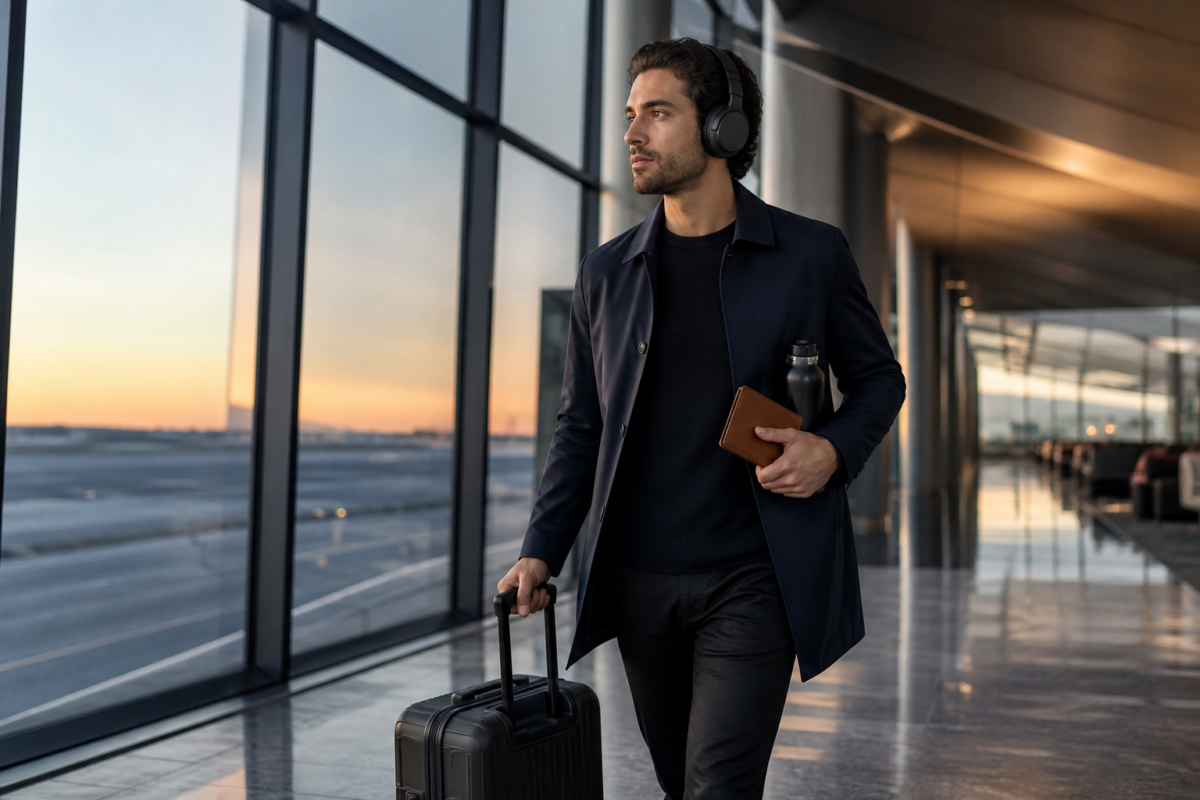
Quick answer: The airport essentials worth owning are noise-cancelling headphones, a slim travel wallet, a compact cable organiser, a quality carry-on or weekender bag, and a leather luggage tag. Add a portable battery, a good travel adapter, and a water bottle, and nothing at the airport will catch him unprepared. The goal is a kit that removes friction from the moment he leaves the house to the moment he lands — not gadgets for edge-case scenarios.
This is the editorial piece: the complete airport kit, explained properly.
The philosophy of a good airport kit
Most airport gear is bought reactively — he forgot a cable, bought a bad adapter in the terminal, grabbed a bottle of water because his wasn’t full when he got through security. Reactive buying at airports is expensive and bad. A deliberately assembled kit eliminates all of that permanently.
The airport experience breaks into five phases: leaving the house, getting through security, the terminal, the flight, and landing. A well-built kit addresses each phase, with no surplus.
The one-line rule: Your airport kit should make the process invisible — if you’re thinking about the kit at the airport, something in it isn’t working.
The complete airport kit, phase by phase
Phase 1: Leaving the house
The essentials that make getting out of the door frictionless.
A quality carry-on or weekender bag. The most important decision is the bag. For a two-night trip with only cabin luggage, a 24–28L travel backpack or a 35–40L weekender gives enough space without encouraging over-packing. See our guides to the best travel backpacks for business travel and best weekender bags for men.
A slim travel wallet or document organiser. Passport, boarding card (or phone), payment cards, travel insurance reference, and some local currency. Everything in one place, accessible in a second. The Bellroy Travel Wallet (around £60–£80) or Smythson Panama Travel Wallet (around £150–£200) handle this properly.
Packing cubes. For carry-on travel, packing cubes make the difference between a bag that stays organised throughout and one that becomes a jumbled mess by day two. Peak Design Packing Cubes or Eagle Creek Specter compression cubes are the worth-owning options.
A leather luggage tag. Even for cabin bags — it identifies the bag quickly at the belt and on the overhead-bin clip. A monogrammed leather tag from Aspinal or Ettinger (around £35–£55) is the no-brainer purchase.
Phase 2: Getting through security
The security phase rewards preparation and punishes disorganisation.
A compact cable and tech organiser. Put the laptop in a dedicated sleeve, chargers and cables in an organiser, and liquids in a clear zip pouch before he leaves the house. The Bellroy Tech Kit (around £50–£60) holds all cables flat and opens in one motion at the tray.
A clear 1-litre liquids bag. Required by most airports. Buy a proper resealable silicone bag rather than the disposable ones — he can reuse it indefinitely. Stasher bags or basic TSA-compliant pouches all work.
Laptop sleeve. If his laptop is in a sleeve rather than buried in a bag, it clears the security tray in seconds and goes back in cleanly. A quality leather sleeve from Pad & Quill or Knomo (around £60–£100) does the job and protects the machine.
A belt and shoes system. Not an accessory — a habit. Wearing shoes that slip off easily, and keeping a belt in the bag rather than wearing it, makes his security run noticeably faster than most people around him.
Phase 3: The terminal
Between security and boarding, the terminal is about staying productive, fed, and calm.
Noise-cancelling headphones. The most impactful terminal buy. Gate announcements, boarding chaos, children — all of it can be reduced to background hum. Sony WH-1000XM5 or Bose QuietComfort Ultra (around £280–£380) are the current benchmarks. See the best gifts for men who travel frequently for a full breakdown.
A portable battery pack. Airport USB charging points are consistently unreliable. A Zendure SuperMini (around £40–£55, 10,000mAh) charges his phone twice and fits in a jacket pocket. For the man who needs to charge a laptop, Anker 737 (around £80–£100, 24,000mAh, 140W) is the choice.
A refillable water bottle. Fill it after security. The Klean Kanteen TKPro 500ml (around £30–£40, insulated) keeps drinks cold for 20 hours. Avoids buying three bottles of overpriced water across the journey.
A quality pen. He’ll need to fill in an immigration card, sign a hotel document, or write something down at some point. Carrying a pen that doesn’t run out on the first form is a small and permanent improvement.
Phase 4: The flight
The flight is where most kit investments pay back most visibly.
Noise-cancelling headphones. The overhead cabin is loud. The difference between flying with and without proper ANC headphones is, for most frequent travellers, the most significant single quality-of-life upgrade available. Both Sony WH-1000XM5 and Bose QuietComfort Ultra are genuinely outstanding.
An eye mask and travel pillow (for long-haul). For short-haul, neither is necessary. For flights over six hours, a quality sleep mask — Alaska Bear Natural Silk (around £10–£15) or MZOO 3D Contour (around £20–£25) — and a compact travel pillow make the difference between landing rested and arriving wrecked.
A merino or cashmere layer. Cabin temperature on long-haul is cold and unpredictable. A lightweight merino zip or cashmere jersey in the bag replaces the complimentary airline blanket with something he actually wants to wear.
Good in-flight entertainment. Download offline content before he flies. Netflix, Spotify (downloaded), Audible, and a long-read — this isn’t a kit item, but it earns a mention because it’s the most commonly forgotten element of a long-haul preparation.
Phase 5: Landing and onward
The moment after landing is where poor preparation causes the most friction.
A multi-region travel adapter. Already important for the hotel room, but critical if he needs to charge at an international airport. The Zendure Passport III (around £40–£55) covers 200+ countries with USB-C PD. He buys it once, carries it forever.
Local currency and a cards-accepted backup. Cash for markets, cabs, and any location that doesn’t take card. Most major airports have currency exchange; his bank’s travel card (Starling, Wise, or Revolut) provides exchange-rate-efficient card spending without the 3% foreign transaction fee.
A TSA/Customs form pen. He’ll need it on the plane or at the gate. Already covered above, but worth re-emphasising for international travel.
The complete airport kit list
| Item | Best pick | Price |
|---|---|---|
| Carry bag | Tumi or Bellroy (backpack) / Mismo or Filson (weekender) | £150–£450 |
| Travel wallet | Bellroy Travel Wallet | £60–£80 |
| Packing cubes | Peak Design or Eagle Creek | £50–£80 |
| Luggage tag | Aspinal or Ettinger (leather, monogrammed) | £35–£55 |
| Cable organiser | Bellroy Tech Kit | £50–£60 |
| Noise-cancelling headphones | Sony WH-1000XM5 | £280–£320 |
| Portable battery | Zendure SuperMini (day) / Anker 737 (laptop) | £40–£100 |
| Water bottle | Klean Kanteen TKPro 500ml | £30–£40 |
| Travel adapter | Zendure Passport III | £40–£55 |
| Pen | Lamy 2000 or Parker Jotter | £15–£120 |
| Eye mask (long-haul) | MZOO 3D Contour | £20–£25 |
| Merino layer | Uniqlo Merino or a cashmere zip | £30–£120 |
The minimal viable airport kit (for occasional travellers)
If he only flies four or five times a year and doesn’t want to build a full kit, these three investments cover most of the friction:
1. Noise-cancelling headphones — the highest single-item impact. 2. A cable organiser — eliminates the tangled-cables problem permanently. 3. A quality leather luggage tag — small, permanent, makes the bag his.
Everything else can be added incrementally.
Frequently asked questions
What should you always have at the airport? Noise-cancelling headphones, a portable battery, a slim travel wallet, a cable organiser, a filled water bottle (after security), and a pen. These address the five most common friction points in every airport experience.
What’s the most important travel accessory for airports? Noise-cancelling headphones, consistently. They reduce terminal chaos, make the flight recoverable, and are used on every journey. The gap between mid-range and top-tier ANC (Sony XM5 or Bose QC Ultra) is significant.
What should I pack in my carry-on for a long-haul flight? Headphones, eye mask, a merino or cashmere layer, a portable battery, downloaded entertainment, and any medication. Long-haul comfort is about those six things, not gadgets.
How do I get through airport security faster? Wear slip-on shoes; put your belt in the bag; put your laptop in an accessible sleeve; put liquids in a clear pouch on top of the bag. Prepare the tray before you reach the belt. These five habits consistently put you through faster than most other travellers.
What’s the best bag for airport travel? A 24–28L carry-on backpack (for carry-on-only travel) or a 35–40L weekender. The backpack has the advantage of being hands-free through the terminal; the weekender handles better in overhead bins. Both should have a luggage pass-through for trips where he checks a roller case.
What travel accessories are worth the money? Noise-cancelling headphones, a quality cable organiser, packing cubes, a leather luggage tag, and a reliable multi-region travel adapter. All five are used on every trip, all improve the experience measurably, and all last years. See our full guide to travel accessories worth buying.
The bottom line
The best airport kit isn’t the one with the most gadgets — it’s the one that removes friction from every phase of the journey without adding bulk. A well-chosen set of headphones, an organised bag, a portable battery, and a slim travel wallet transform the airport experience from something to be endured into something that happens around him while he stays calm and comfortable. Build the kit once. Use it on every trip. Stop thinking about it.
Continue reading
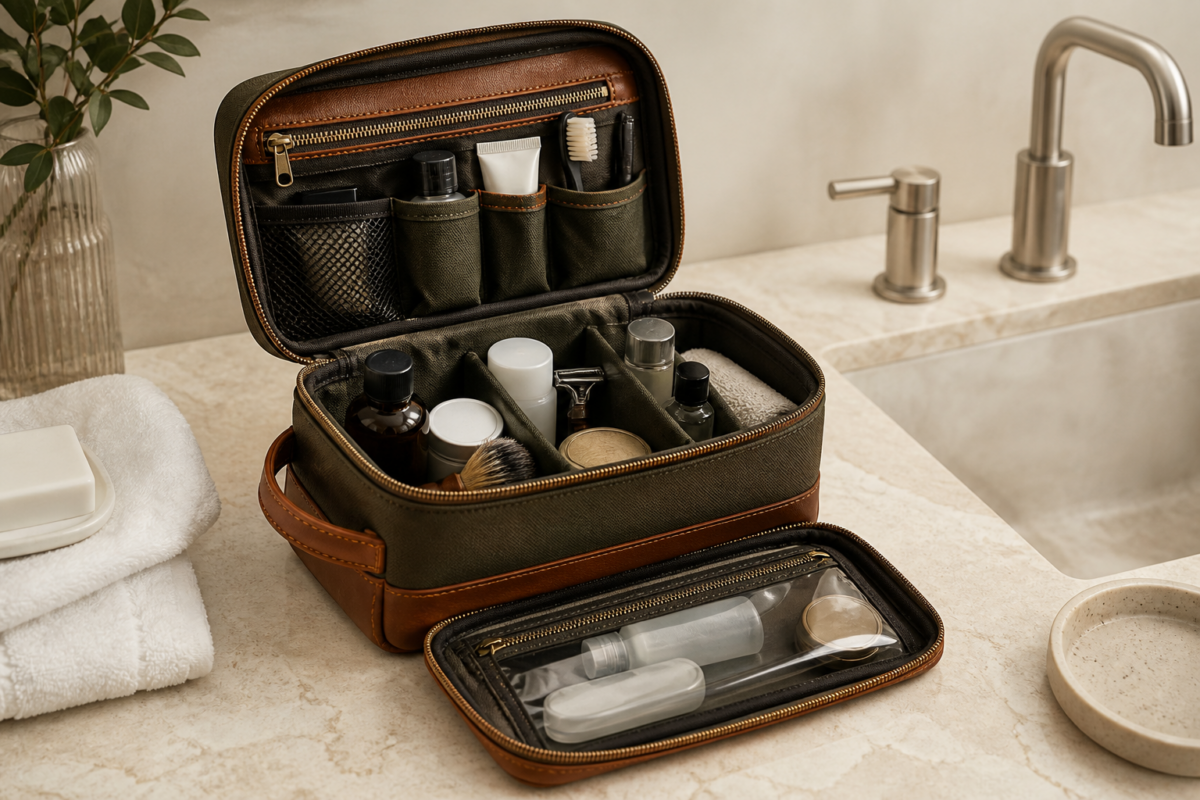
Best Toiletry Bags for Travel (Dopp Kits Worth Owning)
Most men still use the free washbag from a hotel two jobs ago. This is the upgrade that shows every single morning away.
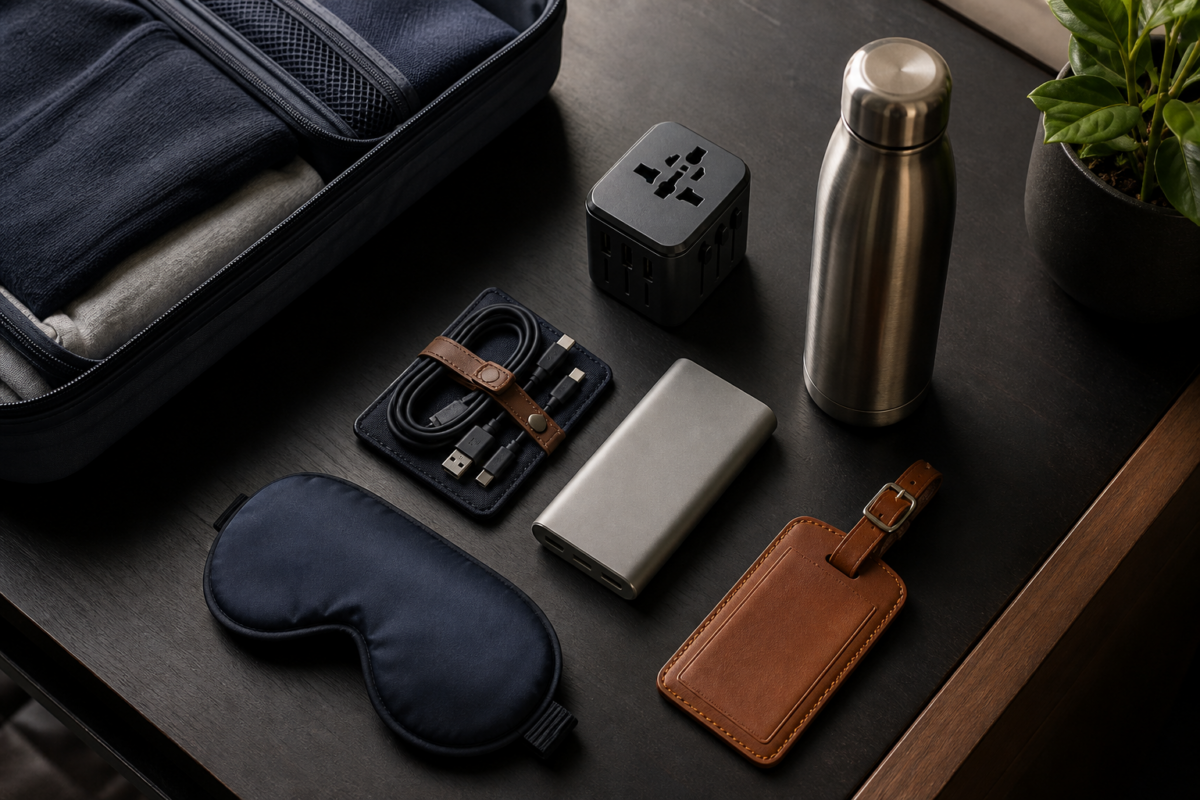
Best Travel Accessories Worth Buying (And the Ones to Skip)
The accessories worth owning solve a problem he has on every trip. Everything else is clutter with good marketing.
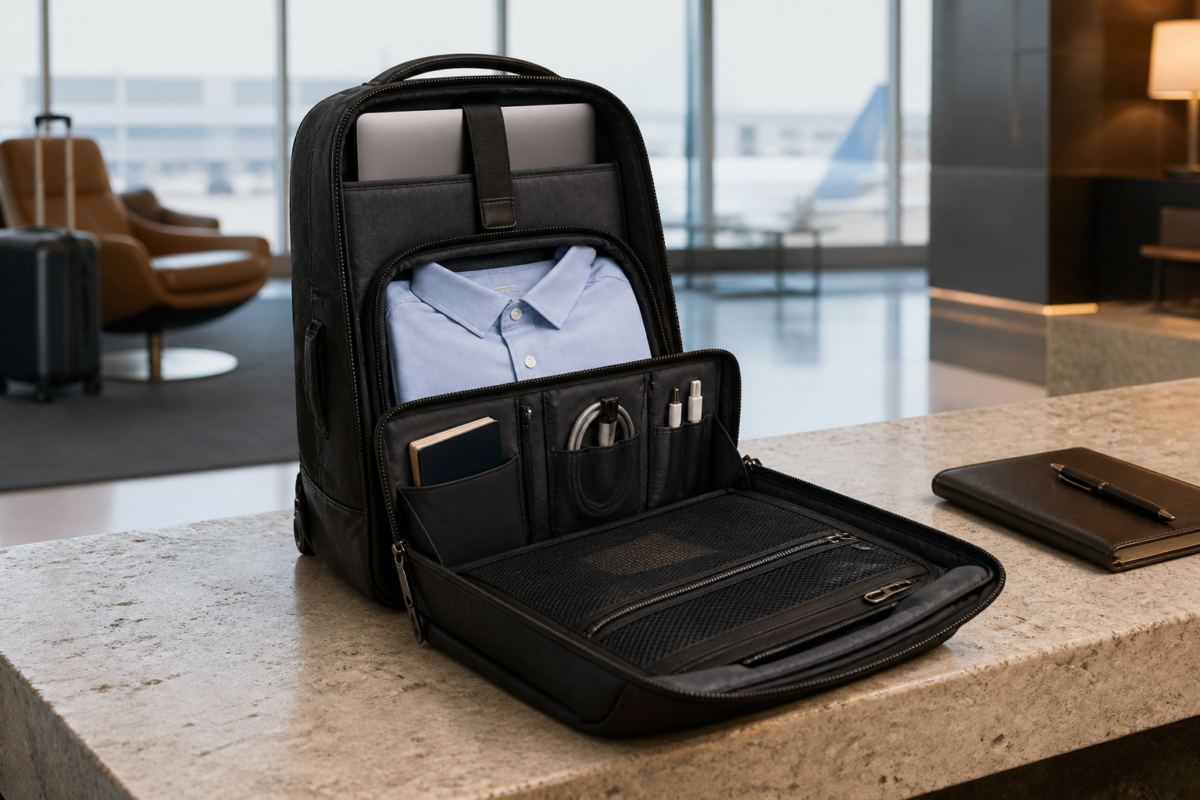
Best Travel Backpacks for Business Travel (That Look the Part)
It has to clear security without unpacking, fit the overhead bin, and look right in a client meeting. Few bags manage all three.